





- HOME
- Payroll compliance
- Salary Deductions, Minimum Wage & Pay Rules in UAE
Salary Deductions, Minimum Wage & Pay Rules in UAE
Salary rules in the UAE go beyond just paying employees on time. What you can deduct, how salary must be structured, whether there is a minimum wage, and when payment is considered late are all defined by Federal Decree-Law No. 33/2021 and enforced through the Wage Protection System. The consequences of getting it wrong range from WPS violations to MOHRE penalties and, in some cases, criminal prosecution.
The minimum wage question alone is more nuanced than most people realise. The UAE does not have a universal minimum wage for expatriate employees, but binding minimums apply to Emiratis in the private sector (AED 6,000/month from January 2026), domestic workers (AED 1,750/month), and qualification-based salary benchmarks guide work permit approvals. This guide covers how salary must be structured, what you can and cannot deduct, what minimum thresholds exist, and how payment must be processed. For the full employment law context, see the UAE Labour Law: The Complete Employer Guide.
Salary Structure: Basic Salary vs Total Package
Before getting into deductions or minimums, it helps to understand how salary is defined under the law. The UAE draws a clear distinction between two terms: basic salary and total salary (wage). This distinction drives how gratuity, overtime, and leave encashment are calculated, so getting the structure right from the start matters.
Basic salary is the fixed amount specified in the employment contract for the work performed. It does not include allowances or non-cash benefits. Total salary includes the basic salary plus all cash allowances and non-cash benefits: housing, transport, phone, education, and any other agreed amounts.
The split matters because gratuity is calculated on basic salary only. Overtime pay is calculated on basic salary. Annual leave encashment uses basic salary. A higher proportion of basic salary means higher end-of-service costs for the employer and better protection for the employee.
There is no legally mandated ratio between basic and total salary. A 60/40 split (60% basic, 40% allowances) is common practice, but it is not a legal requirement. What is required is that the basic salary is clearly stated in the employment contract (Article 54).
Here is what two typical payslips look like in practice. These are modelled on the payslip format generated by Zoho Payroll.
Emirati Employee: HR Coordinator
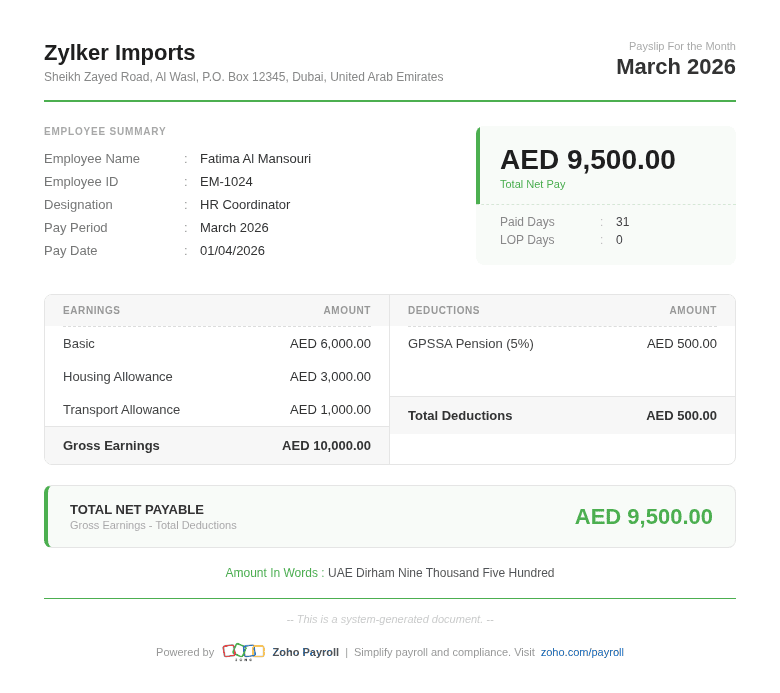
The basic salary of AED 6,000 meets the Emirati private-sector minimum (effective January 2026). Gratuity, overtime, and leave encashment are calculated on the AED 6,000 basic, not the AED 10,000 gross. The GPSSA pension contribution (5% employee share) is deducted monthly, bringing the net salary to AED 9,500.
Expatriate Employee: Accounts Executive
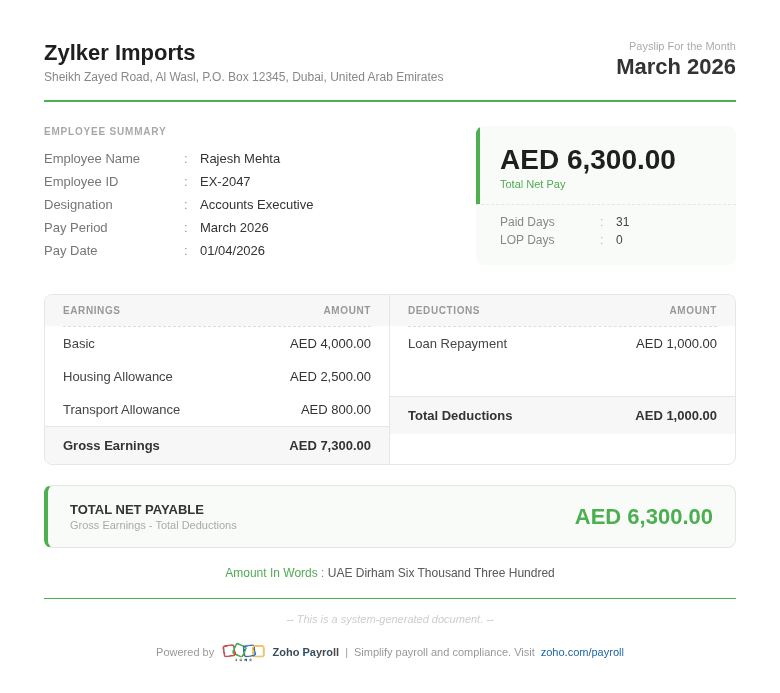
Gratuity, overtime, and leave encashment are calculated on the AED 4,000 basic salary only. The AED 1,000 loan repayment (with the employee's written consent) brings the net salary to AED 6,300, well within the 50% overall deduction cap.
Zoho Payroll lets you customise salary structures based on role, location, or contract type, with clearly defined basic salary and allowance components. This makes sure gratuity, overtime, and leave encashment are always calculated on the correct base.
What Employers Can Legally Deduct
With the salary structure in place, the next question is what can come out of it. Article 25 of Federal Decree-Law No. 33/2021 defines exactly five categories of permitted salary deductions. Anything outside these categories is prohibited.
The Five Permitted Deduction Categories
• Overpayments: Recovering amounts paid to the employee in excess of their entitlements. Capped at 20% of monthly wages per deduction.
• Social contributions and savings funds: Contributions to pension schemes, savings funds, insurance, or other benefit programmes approved by MOHRE. Requires the employee's written consent. Capped at 20%.
• Loan repayments: Recovering loans granted to the employee, with written consent. The employer may not charge interest on these loans.
• Court-ordered debts: Amounts owed under a court judgment. Capped at 25% of wages, except for alimony, where the court may allow a higher percentage.
• Damage caused by the employee: If the employee's negligence or violation of instructions caused damage to company property, the employer can deduct repair costs. Capped at 5 days' wages per month, and the employer must obtain court approval to deduct more.
The 50% Overall Cap
Regardless of how many deduction categories apply in a given month, the total of all deductions cannot exceed 50% of the employee's monthly wage. If an employee has multiple active deductions (for example, a loan repayment and a court-ordered debt), the employer must make sure the combined amount stays within this limit.
What Employers Cannot Deduct
The law is equally clear about what is off-limits. These prohibitions apply regardless of what the employment contract says.
• Recruitment and visa costs: The employer bears all costs of hiring, including travel, visa issuance, medical examinations, and residency permits. Deducting these from the employee's salary is illegal.
• Bank or exchange house charges: Any fees associated with transferring salary through WPS or other banking channels are the employer's responsibility.
• Arbitrary deductions: Any deduction that does not fall within the five categories in Article 25 is prohibited. "Administrative fees," "processing charges," or "security deposits" that are not covered by the law cannot be deducted.
• Deductions without consent: Except for court-ordered debts, all deductions require the employee's written consent.
If an employee believes their employer has made an unlawful deduction, they can file a complaint through the MOHRE complaints portal or through the MOHRE mobile app.
Minimum Wage: What Actually Exists
The short answer to "is there a minimum wage in the UAE?" is: it depends on who you are hiring. Article 26 of the law states that the Cabinet may set a minimum wage, but as of March 2026, no universal minimum has been established for the general expatriate private-sector workforce. That said, several binding minimums do exist.
Emirati Employees in the Private Sector
From 1 January 2026, the minimum wage for Emirati employees in the private sector is AED 6,000 per month (up from AED 5,000). This applies to all new, renewed, and amended work permits. Employers who had Emiratis on staff before the effective date have until 30 June 2026 to adjust salaries. Companies that do not comply face work permit suspensions, and those employees will not count toward Emiratisation targets.
Domestic Workers
Domestic workers have a separate minimum under Ministerial Decree No. 52/2023: AED 1,750 per month for a standard 40-hour work week. Domestic workers are governed by their own law (Federal Decree-Law No. 9/2022), not the general labour law.
Qualification-Based Salary Benchmarks
While not minimum wages in the strict legal sense, immigration authorities apply salary benchmarks when approving expatriate work permit applications. If the offered salary falls significantly below these thresholds for a given qualification level, the work permit may be rejected:
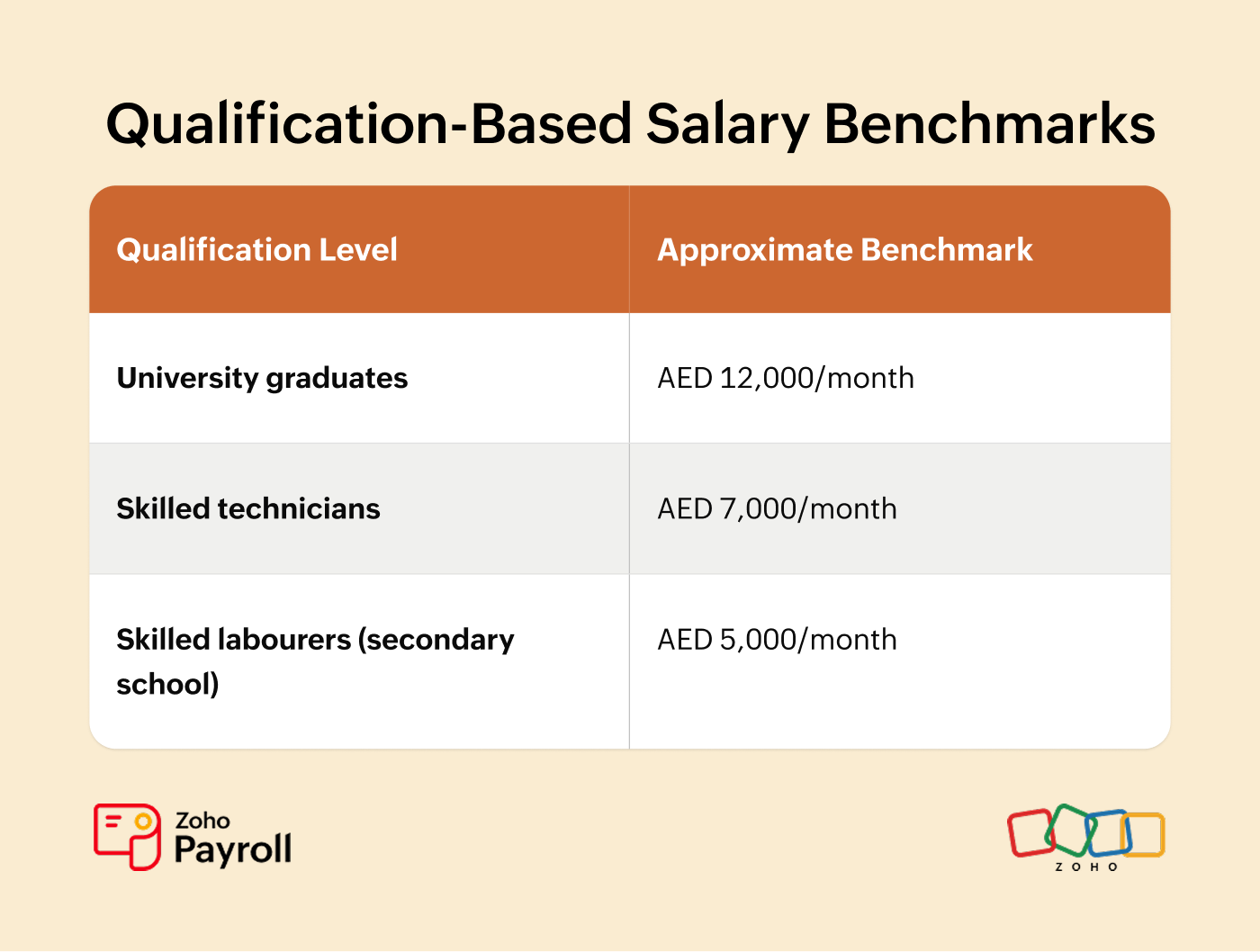
These benchmarks are not published as legislation, but they are consistently applied in practice. Employers setting salaries for expatriate hires should treat them as practical minimums for work permit approval.
How Salary Must Be Paid
Once salary is structured and deductions are accounted for, the final piece is how and when payment must happen. All private-sector employers must pay salaries through the Wage Protection System (WPS) via approved banks or exchange houses. Cash payments, cheques, or transfers outside of WPS are not compliant.
If the employment contract does not specify a payment schedule, the default is at least once per month. The employer is considered in default if wages are not paid within 15 days of the due date. From that point, MOHRE's penalty escalation moves quickly: official reminders at day 3 and 10, work permit suspension at day 17, and criminal prosecution referral at day 30.
For the full details on WPS registration, SIF file generation, compliant banks, and the penalty timeline, see the WPS UAE: The Complete Employer Guide and the WPS Salary Transfer Deadlines & Payment Timing Rules guide.
Zoho Payrollprocesses payroll through WPS-compliant channels and supports multiple payment frequencies (monthly, biweekly, and more), so you can match the pay cycle to the contract terms without manual workarounds. The free online payslip generator gives employees a transparent breakdown of basic salary, allowances, and deductions every cycle.
Frequently Asked Questions
Q1. Can my employer deduct recruitment or visa costs from my salary?
No. Federal Decree-Law No. 33/2021 prohibits employers from charging employees for recruitment or visa-related costs. All hiring expenses, including travel, visa issuance, medical examinations, and residency permits, are the employer's responsibility.
Q2. What is the maximum salary deduction allowed in the UAE?
The total of all deductions in any given month cannot exceed 50% of the employee's monthly wage, regardless of how many deduction categories apply. Individual categories also have specific caps: 20% for overpayments and fund contributions, 25% for court-ordered debts, and 5 days' wages for damage.
Q3. Is there a minimum wage in the UAE?
There is no universal statutory minimum wage for expatriate employees. However, Emirati employees in the private sector have a minimum of AED 6,000/month (from January 2026), domestic workers have a minimum of AED 1,750/month, and immigration authorities apply qualification-based salary benchmarks when approving work permits.
Q4. What happens if my employer pays me late?
MOHRE tracks salary payments through WPS. If your employer does not pay within 15 days of the due date, they are in default. Penalties escalate from official reminders (day 3 and 10) to work permit suspension (day 17) to criminal prosecution referral (day 30).
Q5. Does basic salary include allowances?
No. Basic salary is the fixed amount paid for the work itself, as stated in the employment contract. It does not include housing, transport, or other allowances. This distinction matters because gratuity, overtime, and leave encashment are all calculated on basic salary only. For more on how this affects end-of-service benefits, see the UAE Gratuity: Complete Guide.
Set Up Salary Structures and Deductions as per the Law
Getting salary structures, deductions, and payment timing right is not just about compliance. It is about protecting your business from WPS violations and MOHRE penalties while giving employees confidence that their pay is handled correctly. Zoho Payroll lets you configure salary structures with clearly defined basic and allowance components, process payroll through WPS-compliant channels, and give employees a transparent payslip every cycle.
Start your free trial to set up salary structures and deductions that match the law.