





- HOME
- Payroll compliance
- GPSSA & ADPF Pension: UAE National Employee Contributions Guide
GPSSA & ADPF Pension: UAE National Employee Contributions Guide
The UAE's pension system exists to protect the long-term financial security of its citizens. Through mandatory contributions during their working years, Emirati employees build a guaranteed income for retirement, along with financial protection for their families in the event of disability or death in service. For employers, contributing to this system is both a legal obligation and a direct investment in the national workforce.
Two authorities manage pension contributions in the private sector: GPSSA (General Pension and Social Security Authority) covers employees in Dubai, Sharjah, Ajman, Ras Al Khaimah, Fujairah, and Umm Al Quwain. ADPF (Abu Dhabi Pension Fund) covers employees in Abu Dhabi. Both require the employer to register the employee, deduct the employee's share from their salary, add the employer's share on top, and submit the total by a monthly deadline. The obligations apply equally to small businesses and large enterprises.
The contribution rates, salary caps, and registration rules changed significantly under the 2023 Pensions Law (effective 2 October 2023 for GPSSA, 1 December 2023 for ADPF). The employee share more than doubled for new hires, rising from 5% to 11%. Whether the old or new rates apply depends on when your employee started. This guide walks through both systems side by side: who they cover, what the current rates are, what salary base to use, how to register, what the deadlines are, and what happens if you miss them. For the broader Emiratisation context, see the Emiratisation UAE: Quotas, Penalties & Compliance Guide. For how pension deductions fit into the broader payroll picture, see the Salary Deductions, Minimum Wage & Pay Rules in UAE guide.
Which Authority Applies to Your Employees?
The pension system that applies is based on where your company operates, not where the employee lives.
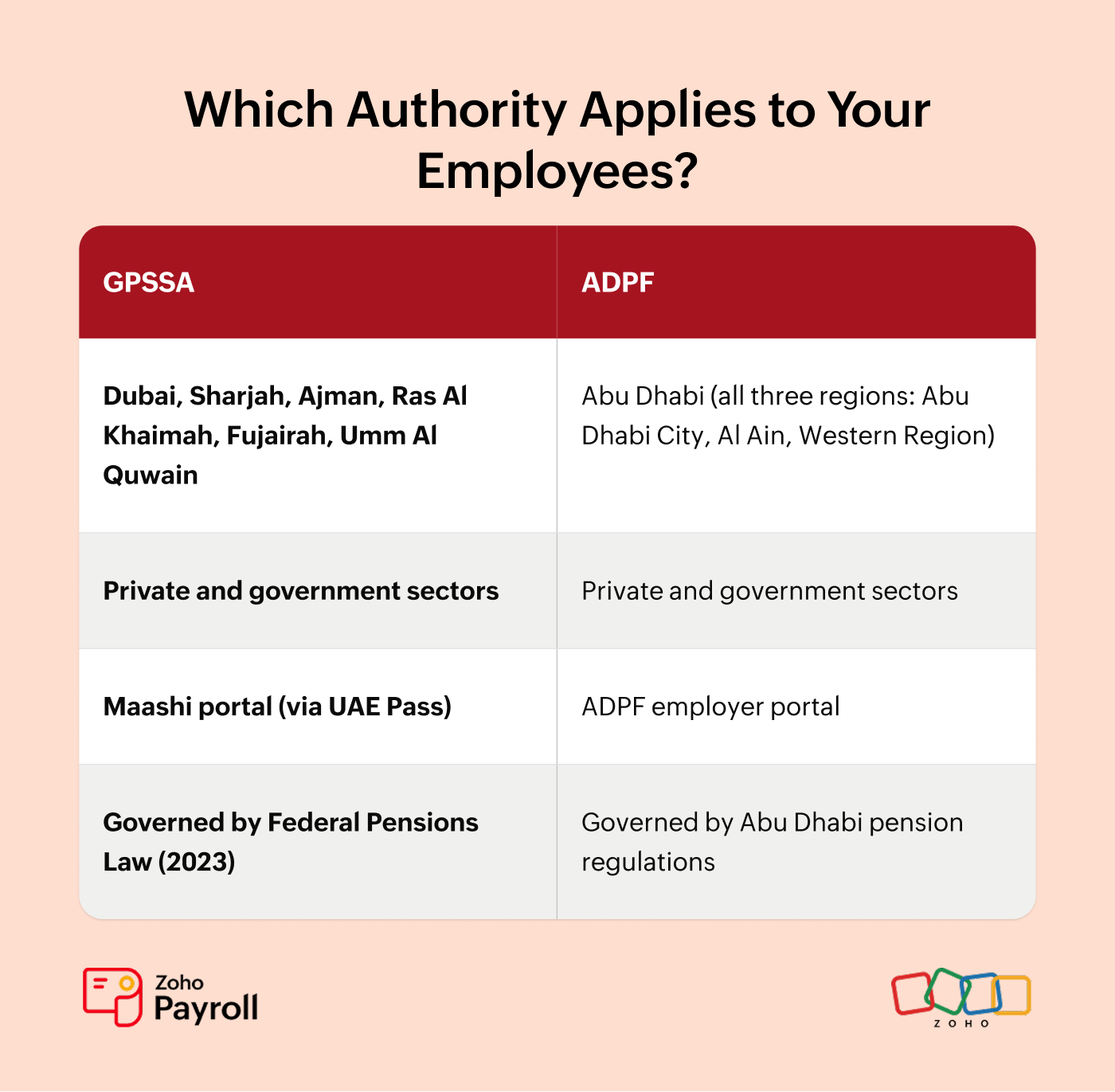
Both systems are mandatory. There is no opt-out. If you employ UAE nationals, you must register them with the correct authority and contribute every month. Military and Ministry of Interior employees fall under separate pension funds and are not covered here.
If your company has offices in multiple emirates (for example, headquarters in Abu Dhabi and a branch in Dubai), employees are registered based on the office they work from. An Emirati employee in your Dubai office goes through GPSSA; one in your Abu Dhabi office goes through ADPF. Getting this right from the start prevents registration errors and potential penalties down the line.
These rules apply to UAE nationals only. If you also employ GCC nationals (from Saudi Arabia, Bahrain, Kuwait, Oman, or Qatar), they are not registered with GPSSA or ADPF. GCC nationals are covered by a separate system, the GCC Unified Protection Extension, where their pension follows their home country's rules and contributions go to a designated UAE bank rather than to either pension authority.
Contribution Rates
Now that you know which authority applies, the next question is how much. The rates depend on two things: which authority covers your employee, and when they started working. The 2023 Pensions Law raised the employee share from 5% to 11% for new hires. Existing employees who were registered before the law took effect remain at 5% unless they opt into the new law. The employer share stayed at 15% under both the old and new laws.
GPSSA Rates (Dubai, Sharjah, and Other Emirates)
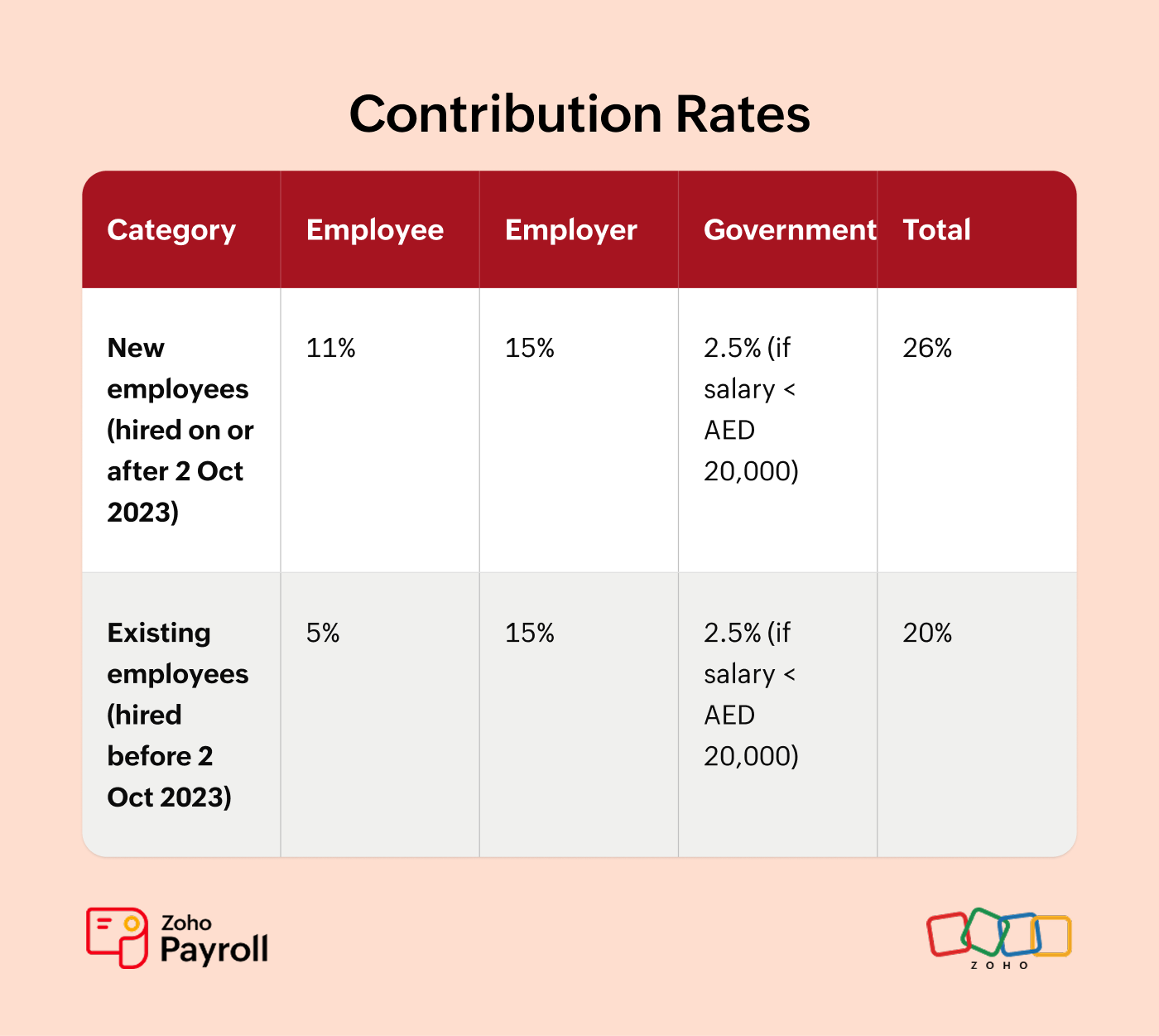
The 2.5% government share applies only to private-sector employees earning less than AED 20,000 per month. It reduces the effective employer cost from 15% to 12.5%. For employees earning AED 20,000 or more, the employer pays the full 15%. This subsidy was introduced to encourage private-sector Emiratisation by reducing the cost of hiring UAE nationals at entry and mid-level salary ranges.
The salary caps under the new law also increased. Under the old 1999 law, the private-sector cap was AED 50,000. The 2023 law raised it to AED 70,000 for GPSSA and AED 100,000 for ADPF new members. This means higher-earning Emirati employees now have more of their salary covered by pension contributions, which translates to a higher pension at retirement but also a larger monthly cost for the employer.
ADPF Rates (Abu Dhabi)
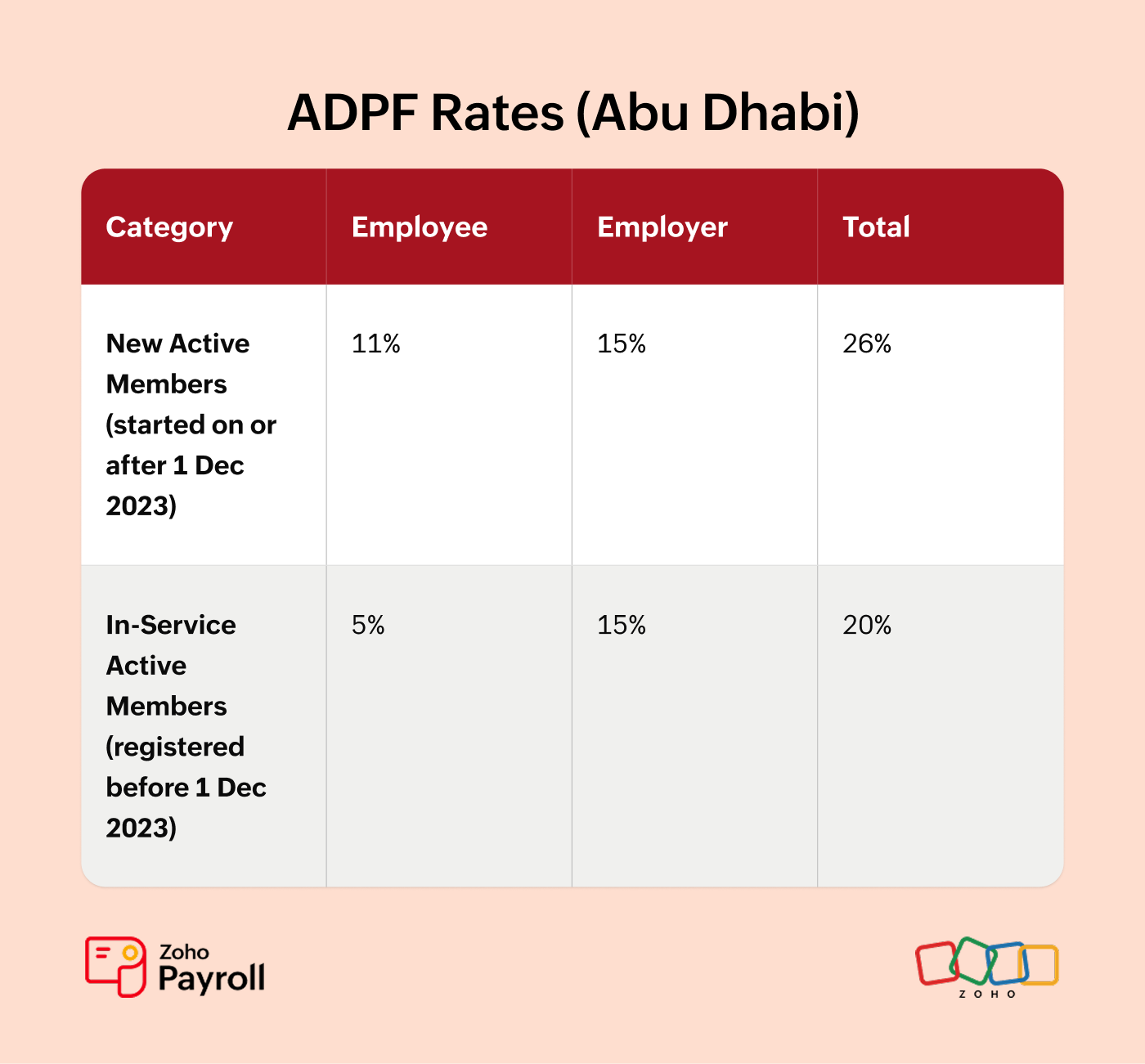
The employer share is 15% across both authorities and both laws. What changed under the 2023 law is the employee share: from 5% to 11% for new hires. This is a payroll deduction, meaning it comes out of the employee's salary. The employer withholds the 11% (or 5%) from the employee's monthly pay, adds its own 15% on top, and submits both shares to the pension authority together.
Which Rate Applies to Your Employee?
The dividing line is the hire date. For GPSSA, any UAE national who started employment on or after 2 October 2023 falls under the new law and pays 11%. For ADPF, the cutoff is 1 December 2023. Employees who were already registered before these dates continue at 5% under the old law, unless they choose to opt into the new law voluntarily.
In practice, this means many employers are running two rates simultaneously: 5% for long-serving Emirati staff and 11% for recent hires. Your payroll system needs to track both, which is one of the reasons getting salary structures right matters. If an existing employee (at 5%) leaves and later rejoins the same or a different company after the cutoff date, they are treated as a new employee and move to 11%.
The impact on the employee's take-home pay is significant. An Emirati earning AED 30,000 per month under the old law would see AED 1,500 deducted (5%). Under the new law, the same employee would see AED 3,300 deducted (11%). While the higher rate builds a larger pension over time, it is worth discussing with employees during onboarding so they understand the deduction on their first payslip.
What Salary Is the Contribution Calculated On?
Pension contributions are calculated on the contribution salary, not on gross pay. The contribution salary is the basic salary plus all fixed monthly allowances specified in the employment contract: housing allowance, cost of living allowance (COLA), social/children allowance, and any other regular fixed allowance.
One-time bonuses, performance bonuses that are not guaranteed monthly, overtime payments, and gratuity amounts are not included in the contribution salary. This distinction is important because many employers mistakenly calculate contributions on the full gross salary, which leads to over-deducting from employees and overpaying to the pension authority.
Salary Caps
Both authorities cap the contribution salary. If your employee earns more than the cap, contributions are calculated on the cap amount, not the full salary.
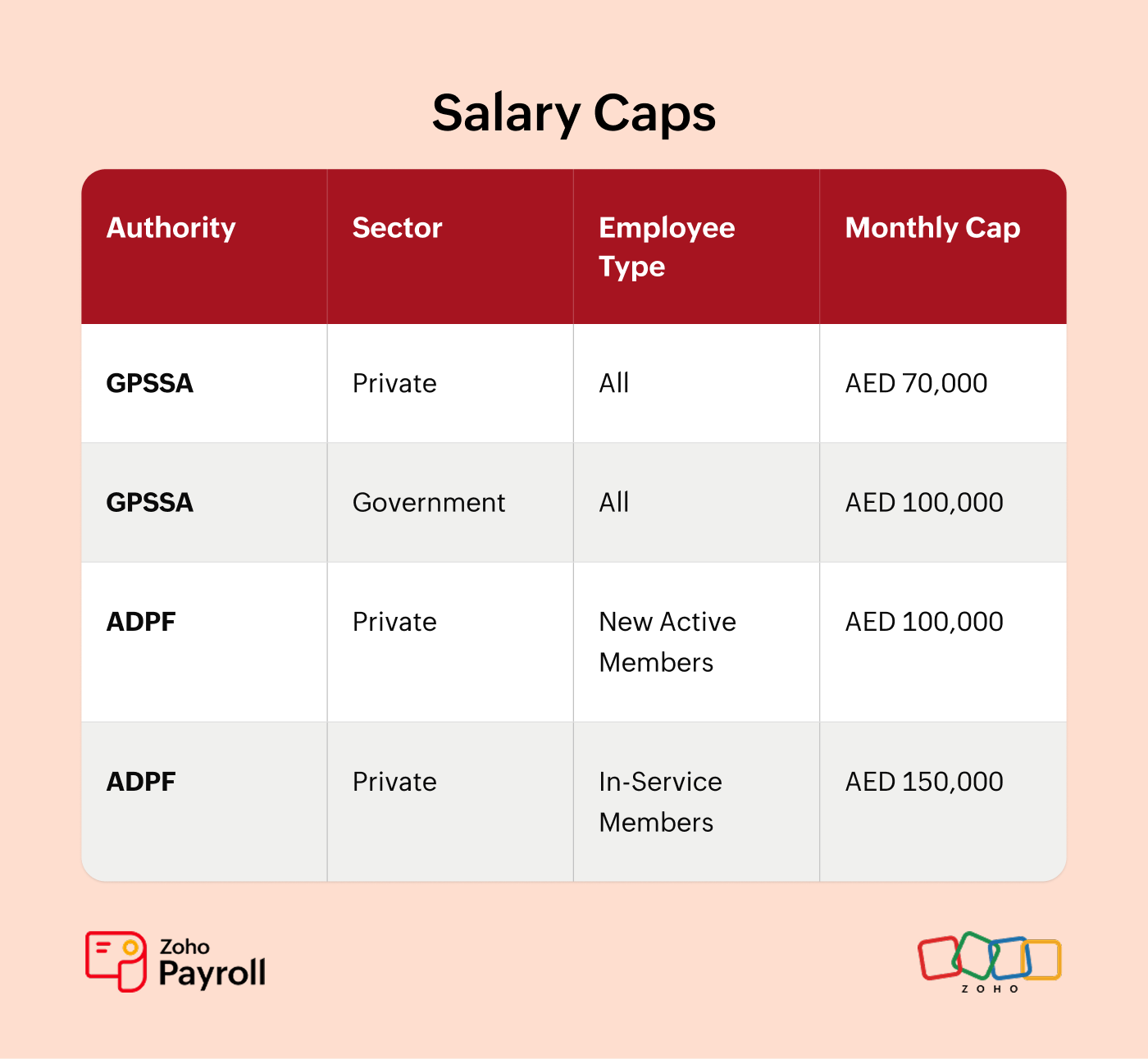
The minimum contribution salary under GPSSA is AED 3,000 per month.
Worked Examples
Example 1 (below cap): An Emirati employee hired in January 2024 at a Dubai company earns AED 25,000 per month in contribution salary. GPSSA applies. Employee deduction: 11% of AED 25,000 = AED 2,750. Employer contribution: 15% of AED 25,000 = AED 3,750. Total submitted to GPSSA: AED 6,500. Since the salary is above AED 20,000, no government subsidy applies.
Example 2 (above cap): An Emirati employee hired in March 2024 at a Dubai company earns AED 80,000 per month in contribution salary. GPSSA private sector cap applies: AED 70,000. Employee deduction: 11% of AED 70,000 = AED 7,700. Employer contribution: 15% of AED 70,000 = AED 10,500. Total submitted to GPSSA: AED 18,200.
Example 3 (government subsidy): An Emirati employee hired in June 2024 at a Sharjah company earns AED 15,000 per month. Because the salary is below AED 20,000, the government covers 2.5% of the employer contribution. Employee deduction: 11% of AED 15,000 = AED 1,650. Employer contribution: 12.5% of AED 15,000 = AED 1,875 (after the 2.5% subsidy). Government contribution: 2.5% of AED 15,000 = AED 375.
Zoho Payroll calculates GPSSA and ADPF contributions automatically. It identifies which authority applies based on the employee's emirate, applies the correct rate (11% or 5%) based on the hire date, and caps the contribution salary at the right threshold. The customisable salary structures separate basic salary and allowances clearly, so the contribution salary is already defined in the system. When rates or caps change (as they did under the 2023 Pensions Law), Zoho Payroll updates automatically. You do not need to track legislative changes or reconfigure deductions manually.
How to Register Employees
Registration is the employer's responsibility, not the employee's. You must register each UAE national employee with the correct pension authority within the deadline, or face penalties. Before you can register employees, your company itself must be registered as an employer with the relevant authority. For GPSSA, this means creating an employer account on the Maashi platform using UAE Pass. For ADPF, you register through the ADPF employer portal. Both processes require your business licence and establishment details.
Once your company is set up, you register each Emirati employee individually as they join. Here is what the process looks like for each authority.
GPSSA Registration
• Who registers: The employer, not the employee
• Deadline: Within 1 month from the employee's date of joining
• Platform: GPSSA's Maashi portal, accessed via UAE Pass authentication
• Required documents: Valid Emirates ID copy, signed employment contract, labour card or work permit
• Late registration penalty: AED 5,000 per employee, plus back-payment of all missed contributions
ADPF Registration
• Who registers: The employer
• Deadline: Within 30 days of the employee receiving their Labour Card
• Platform: The ADPF employer portal
• Required documents: Emirates ID, employment contract, labour card
• Late registration penalty: AED 5,000 per employee, plus back-payment of all missed contributions
All documents submitted to GPSSA must be in Arabic or accompanied by a certified Arabic translation. ADPF follows a similar requirement. Keep copies of the registration confirmation for each employee in your records, as you may need them during MOHRE inspections or Emiratisation audits.
Why Registration Matters Beyond Pension?
Registering Emirati employees with GPSSA or ADPF is not just a pension obligation. It is also a requirement for Emiratisation compliance. Without it, the employee may not count toward your hiring quota, and you cannot access Nafis programme benefits. Nafis offers salary support and pension contribution subsidies for eligible private-sector employers hiring UAE nationals. The specific support depends on the programme stream and employer size. For details on eligibility and how to register, see the Nafis UAE: Registration, Portal, Incentives & Salary Thresholds guide.
Zoho Payroll stores employee documents (Emirates ID copies, contracts, work permits, and GPSSA/ADPF registration confirmations) in one centralised platform. When an inspection or audit requires proof of pension registration, the records are already in the system.
Monthly Contribution Deadlines and Penalties
Once your employees are registered, contributions are due every month. Missing a deadline does not result in a warning. The penalty kicks in automatically on the 16th, and there is no grace period. Here is what you need to know.
• Payment deadline: Contributions are due by the 15th of the month following the salary month. January salary contributions, for example, are due by 15 February.
• Late payment penalty: 0.1% per day on the outstanding amount, starting automatically from the 16th. No warning is issued.
• Example: If you owe AED 26,000 in contributions and pay 10 days late, the penalty is AED 26,000 x 0.1% x 10 = AED 260. The amount may seem small, but it compounds and accumulates without notice.
Practical tip: Set your internal payroll deadline a few days early (by the 10th) to allow time for processing and bank transfers before the 15th.
GPSSA announced in early 2025 that it would begin enforcing late payment penalties for GCC national employees (not just UAE nationals) starting 1 July 2025. The penalty structure is the same: 0.1% per day from the 16th. If you employ GCC nationals in addition to Emiratis, the same contribution and payment rules apply.
For small businesses, GPSSA offered a limited penalty waiver between January 2024 and April 2025 for companies with four or fewer Emirati employees. This waiver covered late registration and delayed end-of-service processing. The waiver has since expired, so all employers are now subject to the standard penalty framework.
Pension Eligibility and End-of-Service
When an Emirati employee leaves your company, their end-of-service entitlement is handled through GPSSA or ADPF, not through the standard UAE Labour Law gratuity formula that applies to expat employees. The pension authority calculates the benefit based on the employee's contribution history, years of service, and the applicable pension law. Understanding how this works helps you plan for the financial impact of employee departures and set the right expectations during offboarding.
• End-of-service gratuity (under 15 years): If the employee leaves before completing 15 years of contributory service, GPSSA or ADPF pays a lump-sum gratuity. The amount is based on the average contribution salary and years of service.
• Retirement pension (15 years or more): Starts at 60% of the average contribution salary (calculated from the last 5 years) and increases by 2% for each additional year, up to a maximum of 100% after 35 years.
• New law cap on gratuity: Under the 2023 Pensions Law, gratuity is not paid on salary amounts exceeding the pensionable cap. For GPSSA private sector, that means AED 70,000. For ADPF new members, AED 100,000.
Pension Percentage by Years of Service
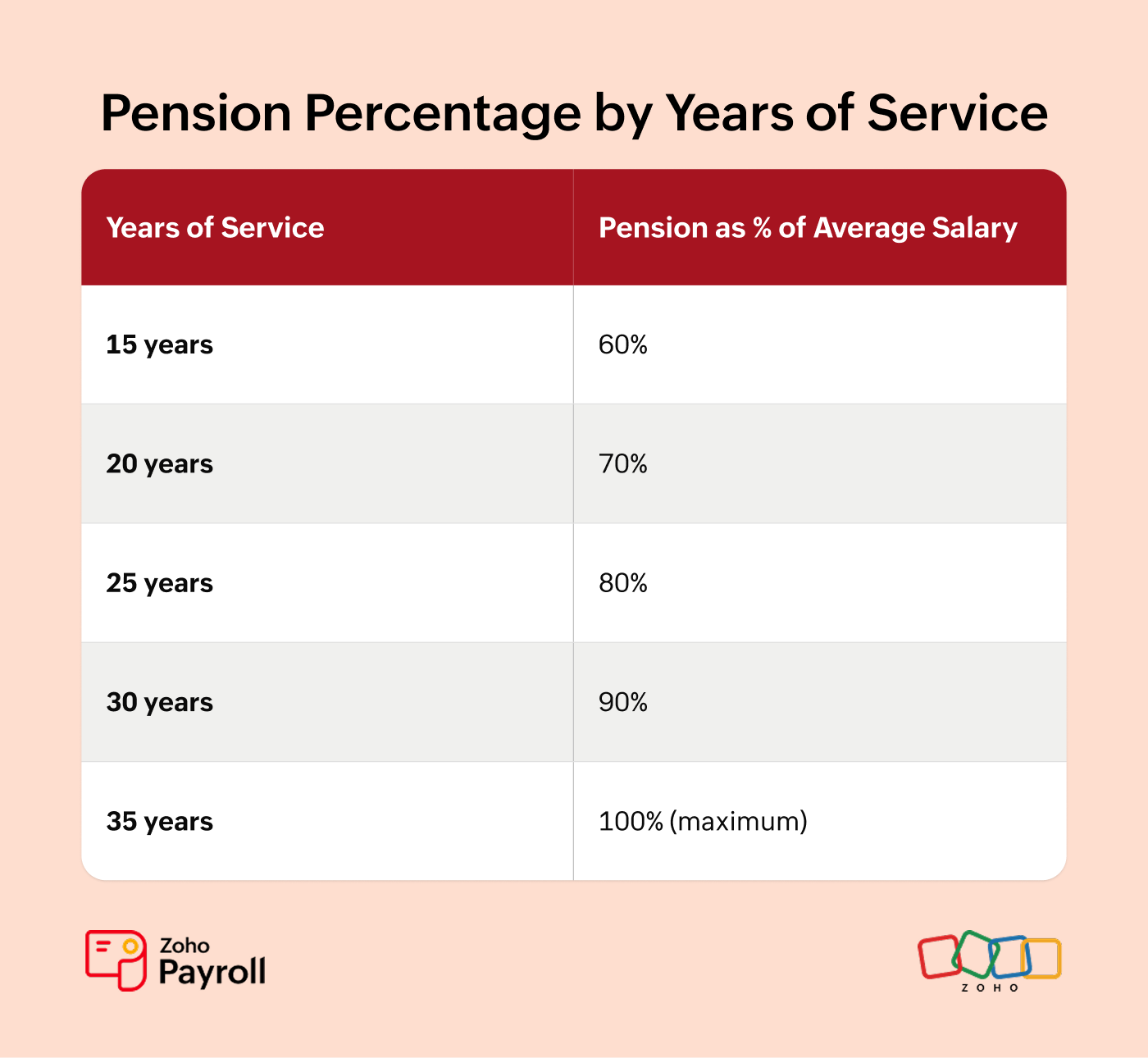
The average contribution salary is calculated from the employee's last 5 years of service. If the employee's salary increased over time, the pension reflects the higher earning years, not the starting salary.
Unlike the standard Labour Law gratuity (which the employer pays directly to expat employees), the Emirati end-of-service benefit is paid by the pension authority from the accumulated contributions. The employer's obligation is to make sure contributions are submitted correctly each month. Service periods are cumulative, so if an employee worked at multiple companies, their total GPSSA or ADPF contribution history carries over.
When you initiate an employee exit in Zoho Payroll, gratuity is calculated automatically based on the contract type, separation type, and applicable rules. The system accounts for the pensionable salary cap when calculating gratuity under the new law. If the pension rules change, the gratuity logic updates automatically. You can also use the free online gratuity calculator to estimate end-of-service costs before an employee's exit is formalised.
What the Payslip Should Show
Transparency matters. Your Emirati employees should see exactly how much pension is being deducted and on what salary base. A well-structured payslip for a GPSSA-covered employee should include the following:
• Basic salary: The base amount specified in the employment contract
• Fixed allowances: Housing, COLA, social/children allowance, and any other regular allowance
• Contribution salary: The sum of basic salary and fixed allowances (capped at the applicable limit)
• GPSSA/ADPF pension deduction: Shown as a separate line item with the percentage and AED amount
• Net salary: The take-home amount after the pension deduction and any other applicable deductions
The free online payslip generator fromZoho Payroll formats the pension deduction as a clear, separate line item so employees can see exactly what is being withheld. When you run payroll through Zoho Payroll, the pension calculation, salary cap, and payslip formatting are all handled automatically.
Common Mistakes Employers Make
Pension calculations are not complicated once you know the rules, but the number of variables (authority, rate, salary base, cap, hire date) creates room for error. GPSSA has increased its compliance scrutiny since 2024, conducting more audits and issuing penalties more consistently. These are the mistakes that trip employers up most often:
• Wrong salary base: Calculating contributions on gross salary instead of contribution salary (basic + fixed allowances only). Overtime, one-time bonuses, and performance bonuses should not be included.
• Ignoring salary caps: Not capping the contribution salary at AED 70,000 (GPSSA private) or AED 100,000 (ADPF new members) before applying the percentage.
• Applying the wrong rate: Using 5% for all employees regardless of hire date. Employees hired after 2 October 2023 (GPSSA) or 1 December 2023 (ADPF) pay 11%, not 5%.
• Missing the registration deadline: Failing to register within 1 month (GPSSA) or 30 days (ADPF) of the employee starting. This triggers an AED 5,000 fine per employee.
• Paying late: Missing the 15th-of-the-month deadline and incurring the automatic 0.1% daily penalty without realising it.
• Not claiming the government subsidy: For private-sector employees earning less than AED 20,000, the government covers 2.5% of the employer's contribution. Not accounting for this means the employer overpays.
• Unclear payslips: Not showing the pension deduction as a separate, clearly labelled line item on the payslip. Employees should see exactly how much is being deducted and on what basis.
• Not updating salary changes: When an employee receives a salary increase, the contribution salary changes too. Failing to update the pension authority means you are under-contributing, which can result in back-payments and penalties during an audit.
• Confusing contribution salary with net salary: Pension contributions are calculated on the contribution salary before other deductions (loan repayments, salary advances). Calculating on net pay leads to under-contribution.
Most of these mistakes come from manual calculation or not keeping up with regulatory changes. Zoho Payroll handles pension calculations automatically: correct authority, correct rate, correct salary cap. When rules change, the system updates on its own. The payslip generator shows the pension deduction as a clear, separate line item. This removes the guesswork and reduces the risk of errors that lead to penalties.
Frequently Asked Questions
Q1. What is the difference between GPSSA and ADPF?
GPSSA covers UAE nationals working in Dubai, Sharjah, Ajman, Ras Al Khaimah, Fujairah, and Umm Al Quwain. ADPF covers UAE nationals working in Abu Dhabi. Both are mandatory pension authorities, but they operate independently with slightly different salary caps and registration platforms. The contribution rates (11% employee, 15% employer for new employees) are the same across both.
Q2. How much does the employer pay for GPSSA/ADPF?
The employer pays 15% of the employee's contribution salary (basic salary plus fixed allowances, capped at the applicable limit). For private-sector employees earning less than AED 20,000, the government covers 2.5%, reducing the employer's effective cost to 12.5%. For an employee at the GPSSA private-sector cap of AED 70,000, the employer pays AED 10,500 per month. This is a cost on top of the employee's salary, not deducted from it.
Q3. What happens if I register an employee late?
GPSSA charges an AED 5,000 fine per employee for late registration, plus all back-contributions owed from the date the employee started. The same applies to ADPF. For the back-contributions, the employer must pay both the employee and employer shares for every month the employee was unregistered. Penalties can add up quickly if multiple employees are involved or if the delay spans several months.
Q4. Does my Emirati employee's pension affect their gratuity?
Under the new 2023 Pensions Law, end-of-service gratuity is not paid on salary amounts that exceed the pensionable cap. If your employee earns AED 90,000 per month and falls under GPSSA (private sector cap of AED 70,000), gratuity is calculated on AED 70,000, not the full AED 90,000. For employees under the old (1999) law, different rules may apply.
Q5. Does GPSSA or ADPF apply to GCC national employees?
No. GCC nationals (from Saudi Arabia, Bahrain, Kuwait, Oman, or Qatar) working in the UAE are covered by the GCC Unified Protection Extension System, not GPSSA or ADPF. Their pension benefits follow their home country's pension law. The employer contributes up to the UAE rate (15%), capped at the home country rate, and payments go to a designated UAE bank rather than to GPSSA or ADPF. The employee's service in the UAE counts toward their home country pension.
Q6. Do Nafis benefits cover pension contributions?
Nafis offers salary support and pension contribution subsidies for eligible private-sector employers hiring UAE nationals. The specific support depends on the programme stream and employer size. For full details on eligibility and registration, see the Nafis UAE: Registration, Portal, Incentives & Salary Thresholds guide.
Automate Pension Contributions from Day One
Getting pension contributions right means getting the rates, the salary base, and the deadlines right every month. With two authorities, two rate tiers (old and new law), multiple salary caps, and a government subsidy that only applies below a certain threshold, the manual approach leaves too much room for error.
Zoho Payroll handles all of this automatically. It calculates GPSSA and ADPF contributions based on each employee's emirate and hire date, applies the correct salary cap, and updates when regulations change. The payslip shows every deduction clearly as a separate line item, and gratuity is calculated automatically when an employee exits. Whether the employee falls under the old or new law, the system applies the right rate without manual intervention.
You focus on running the business. The pension math stays current on its own.
The free online payslip generator gives employees a transparent breakdown of their salary, including the pension deduction, every pay cycle.
Start your free trial to automate pension contributions from day one.