





- HOME
- Payroll compliance
- Emiratisation by Sector: Healthcare, Financial Services & More
Emiratisation by Sector: Healthcare, Financial Services & More
Emiratisation is one of the UAE's most significant workforce development initiatives. At its core, the policy is designed to bring Emirati talent into the private sector, building a diverse and sustainable economy that is not solely dependent on expatriate labour. For UAE nationals, it opens doors to meaningful careers across industries that were historically dominated by foreign workers. For employers, it creates an opportunity to invest in local talent, strengthen ties with the communities they operate in, and contribute to the country's long-term economic vision.
The requirements, however, are not the same across every industry. While MOHRE's general mandate (2% annual growth in skilled Emirati roles for companies with 50+ employees, or hiring 1 to 2 Emiratis for companies with 20 to 49 employees in targeted sectors) applies broadly, certain sectors face additional quotas set by their own regulators. Banking and insurance targets come from the Central Bank of the UAE, not MOHRE. Healthcare has a dedicated national training pipeline through Nafis. Understanding which rules apply to your industry is the first step toward compliance.
This guide breaks down the sector-specific Emiratisation landscape: which industries have separate targets, who sets them, what the numbers are, and what happens if you fall short. For the general Emiratisation framework (quotas, penalties, and compliance for all sectors), see the Emiratisation UAE: Quotas, Penalties & Compliance Guide.
The 14 Targeted Sectors
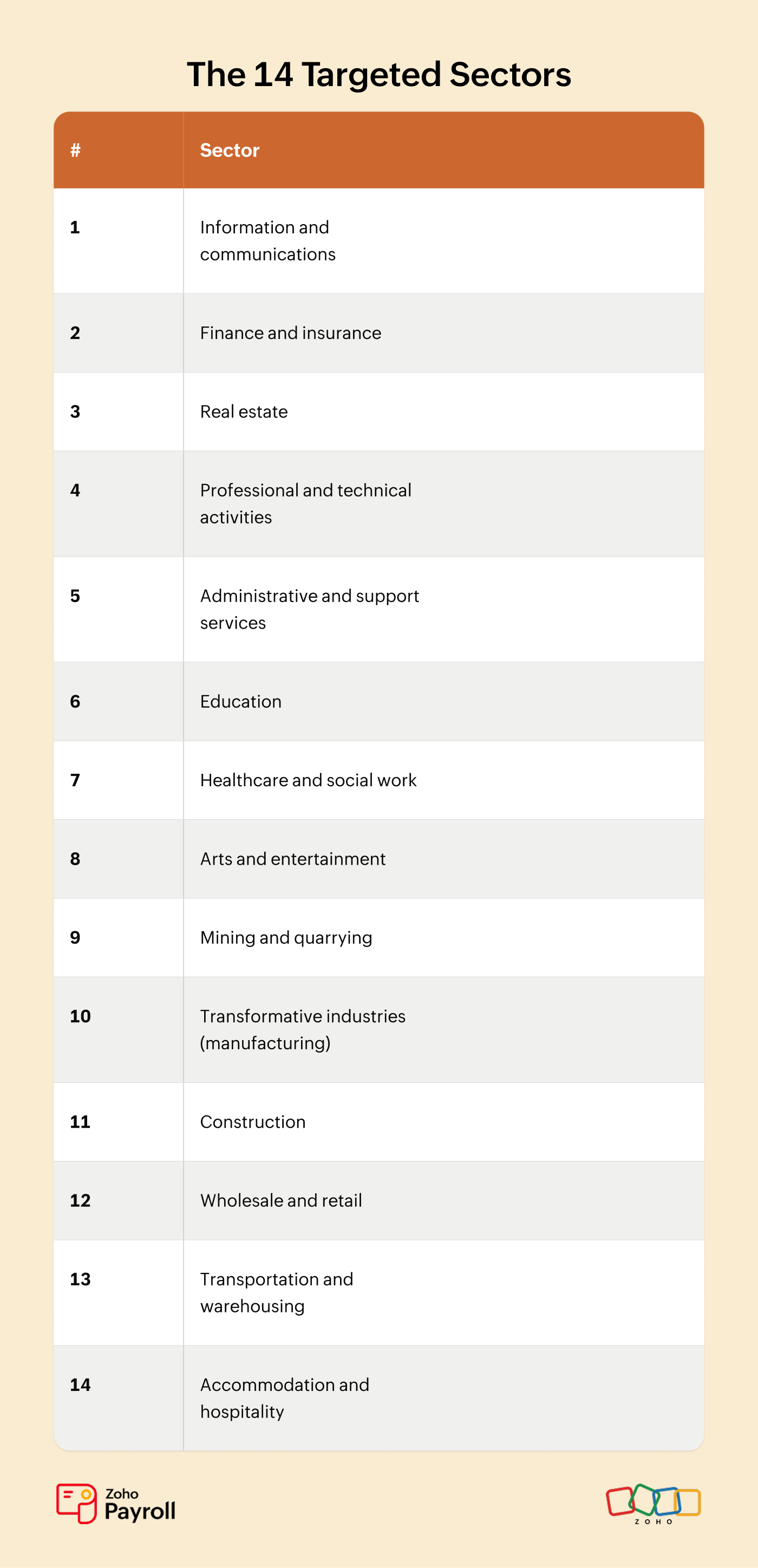
In 2022, MOHRE identified 14 economic sectors subject to Emiratisation targets under Ministerial Resolution 279. In 2023, Resolution 455 expanded these requirements to companies with 20 to 49 employees operating within these sectors. Here is the full list:
What Companies in These Sectors Must Do
Companies with 20 to 49 employees operating in any of the 14 sectors above were required to hire at least one UAE national by the end of 2024 and a second by the end of 2025. Companies that missed those targets have been charged AED 96,000 per unfilled position for 2024 (collected from January 2025) and AED 108,000 per unfilled position for 2025 (collected from January 2026). These penalties recur annually for every year the company remains non-compliant, so a company that still has not hired any Emirati employees is paying both amounts each year.
Companies with 50 or more employees are subject to Emiratisation targets in all sectors (not just the 14 listed above). The target is a 2% annual increase in Emirati representation across skilled roles, reaching 10% by the end of 2026. The same penalty framework applies.
Most of these sectors follow MOHRE's general framework. But a few have their own regulators setting separate, often more aggressive targets. That is where the next section comes in.
Sector-Specific Quotas and Regulators
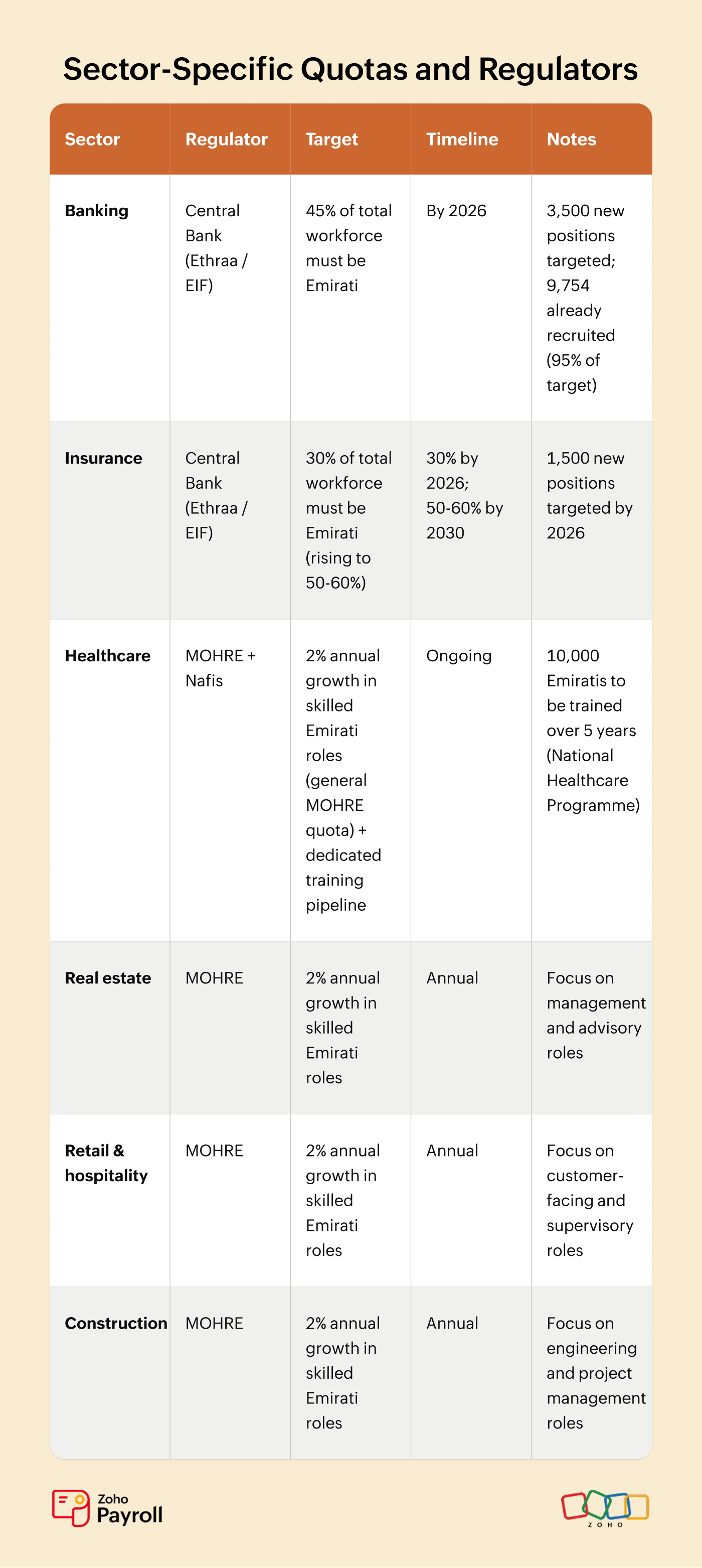
Not every sector plays by the same rules. Banking, insurance, and healthcare each have additional Emiratisation mechanisms that go beyond MOHRE's general mandate. Here is how they compare:
Banking and Insurance: The Ethraa Programme
The banking and insurance sectors have the most aggressive Emiratisation targets in the UAE, and they come from the Central Bank, not MOHRE. The vehicle for this is the Ethraa programme, run by the Emirates Institute of Finance (EIF). Ethraa coordinates recruitment, training, and placement of UAE nationals into banking and insurance roles. The programme has already placed 9,754 UAE nationals across the financial sector, achieving 95% of its initial recruitment target.
For banks, the target is 45% Emiratisation by 2026. For insurance companies, the current target is 30% by 2026, rising to between 50% and 60% by 2030. These targets apply to licensed entities regulated by the Central Bank, regardless of whether they operate on the mainland or in a financial free zone like DIFC or ADGM.
This is an important distinction. MOHRE's general Emiratisation mandate does not typically apply to free zone companies. But if your free zone company holds a Central Bank licence (banks, insurance firms, exchange houses), the Central Bank's Emiratisation targets apply regardless. Non-compliance can affect your licensing conditions.
Healthcare: The Nafis Training Pipeline
Healthcare does not have a separate regulator setting Emiratisation quotas. Instead, the sector benefits from a dedicated supply-side approach through Nafis. The National Healthcare Programme aims to train 10,000 Emiratis for healthcare careers over five years, covering disciplines like nursing, pharmacy, medical laboratory sciences, emergency medical services, physiotherapy, midwifery, and diagnostic imaging.
For employers in the healthcare sector, this creates a growing pool of qualified Emirati candidates. The programme includes a Studying Citizen Employment Contract, which provides job security for trainees during their studies. The Financial Compliance Pathways programme (run by ADGM Academy, EIF, and Nafis) offers a similar pipeline for financial services, preparing Emiratis for compliance and regulatory roles. For full details on Nafis incentives, see the Nafis UAE: Registration, Portal, Incentives & Salary Thresholds guide.
Other Sectors: The General Framework
Sectors like real estate, retail, hospitality, construction, wholesale, transportation, IT, education, and professional services follow MOHRE's general Emiratisation framework. There are no separate sector-specific regulators or additional quotas. The standard rules apply: 2% annual growth for companies with 50+ employees, or hiring 1 to 2 Emiratis for companies with 20 to 49 employees in the 14 listed sectors.
That said, MOHRE does pay closer attention to certain role types within these sectors. Customer-facing roles in retail and hospitality, management positions in real estate and construction, and technical roles in IT and professional services are areas where MOHRE monitors Emirati representation more actively.
What This Means for Your Payroll
Regardless of your sector, every Emirati hire triggers the same set of payroll obligations. The sector-specific targets determine how many Emiratis you need to hire. The payroll fundamentals are the same across the board.
• Pension registration: Every Emirati employee must be registered with GPSSA or ADPF within the first month. For banking and insurance companies meeting aggressive Central Bank quotas, this means registering multiple Emirati hires in a short timeframe. Getting pension setup right from day one avoids the AED 5,000 per-employee late registration penalty.
• Salary structures: Emirati hires in regulated sectors (banking, insurance) often have different compensation packages from non-regulated roles. Salary structures may need to account for sector-specific allowances, Nafis salary support top-ups, or different basic-to-allowance ratios.
• Nafis coordination: If your sector qualifies for Nafis salary support or training subsidies, you need to track enrolment records and subsidy timelines alongside your regular payroll cycle.
• Document management: MOHRE inspections and Central Bank audits both require proof of Emirati employment: pension registration confirmations, employment contracts, Nafis enrolment records, and sector-specific training certificates.
Zoho Payroll helps you stay on top of these requirements. Customisable salary structures let you configure different packages by role, location, or contract type. Pension contributions (GPSSA and ADPF) are calculated automatically based on each employee's emirate and hire date, and update when regulations change. Employee documents (MOHRE registration, Nafis enrolment, training certificates, pension confirmations) are stored in one centralised platform, so when an inspection or audit comes, the records are already there. For a detailed breakdown of pension contribution rates and registration, see the GPSSA & ADPF Pension: UAE National Employee Contributions guide.
What Happens If You Fall Short
The penalty framework depends on which regulator sets your target.
• MOHRE penalties (all sectors): AED 96,000 per unfilled Emirati position for 2024 (collected from January 2025). AED 108,000 per unfilled position for 2025 (collected from January 2026). These are annual financial contributions, not one-time fines. They recur every year you remain non-compliant.
• Central Bank penalties (banking and insurance): In addition to any MOHRE penalties, Central Bank-regulated entities face regulatory consequences that can include conditions on their operating licence, restrictions on new branches, or limitations on product approvals. The Central Bank treats Emiratisation as part of its broader regulatory oversight.
For most sectors, the MOHRE penalty is the primary concern. For banking and insurance, the dual exposure to both MOHRE and Central Bank enforcement makes non-compliance significantly more costly.
Frequently Asked Questions
Q1. Which sectors have the highest Emiratisation quotas?
Banking (45% by 2026) and insurance (30% by 2026, rising to 50-60% by 2030) have the highest targets, set by the Central Bank of the UAE through the Ethraa programme. These are separate from MOHRE's general 2% annual growth mandate that applies to all sectors.
Q2. Does my sector affect the penalty for non-compliance?
MOHRE's financial penalties (AED 96,000 per unfilled position in 2024, AED 108,000 in 2025) apply across all sectors. Banking and insurance companies face additional regulatory consequences from the Central Bank, which can include licensing conditions. The two penalty frameworks can apply simultaneously.
Q3. Is there sector-specific Nafis support?
Yes. The National Healthcare Programme trains Emiratis for healthcare careers (nursing, pharmacy, lab sciences, physiotherapy, and more). The Financial Compliance Pathways programme (run by ADGM Academy, EIF, and Nafis) prepares Emiratis for compliance roles in financial services. Both programs provide direct employment pathways for participating employers.
Q4. Do free zone companies have sector-specific Emiratisation requirements?
Free zone companies are generally not subject to MOHRE's Emiratisation mandates. However, if your free zone company is regulated by the Central Bank (banks, insurance firms, exchange houses in DIFC, ADGM, or other financial free zones), the Central Bank's Emiratisation targets apply regardless of your free zone status.
Get Payroll Right for Every Emirati Hire
Whether your sector faces MOHRE's general quotas or additional targets from the Central Bank, every Emirati hire starts with the same payroll fundamentals: correct salary structure, pension registration, and transparent payslips. Zoho Payroll handles pension calculations automatically, stores employee documents in one platform, and updates when regulations change. You focus on meeting your sector's targets. The payroll stays compliant on its own.
Start your free trial to get payroll right for every new hire from day one.