

- HOME
- Taxes & compliance
- Managing GST/HST on the go: How mobile accounting apps support recordkeeping and tax readiness
Managing GST/HST on the go: How mobile accounting apps support recordkeeping and tax readiness
GST/HST compliance in Canada often takes shape in fragments rather than in one deliberate effort. An invoice is sent as a job ends. A receipt is handed over at a counter. Tax is applied while answering a message between appointments. None of these moments feel significant on their own, and they rarely happen in ideal conditions.
Because of that, compliance challenges usually develop slowly. A missing detail on an invoice doesn’t cause an issue right away. A receipt that isn’t recorded feels harmless at the time. The consequences show up later, when everything needs to be pulled together for filing.
Mobile accounting has become part of this picture simply because it matches how work actually happens now. When accounting tasks move with the business, tax decisions tend to happen earlier—and with fewer gaps.
When compliance decisions happen during the workday
For many businesses, GST/HST compliance used to be something reviewed at month-end or quarter-end. Today, the outcome of a return is shaped long before that.
Most tax decisions don’t feel like decisions at all. Applying a rate, saving an expense, or sending an invoice becomes part of the background noise of a workday. It’s only later—when figures are reviewed together—that the impact of those small steps becomes clear.
Handling them as they come usually keeps records intact. Leaving them for later tends to turn filing into a reconstruction exercise. Having access to the right information while the details are still fresh reduces that reliance on memory and guesswork.
Invoicing while details are still fresh
Issuing invoices on the go has become common across Canada. Contractors invoice from job sites. Consultants send invoices after meetings. Real estate professionals prepare documents between appointments.
Speed helps cash flow, but it also increases the risk of missing something small.
Canadian invoice requirements depend on invoice value, and certain details—such as the supplier’s GST/HST number and the tax charged—are essential for customers to support input tax credit claims. These details matter even more when work crosses provincial boundaries. In many provinces, businesses may also need to apply provincial sales tax (PST) or retail sales tax (RST) in addition to GST/HST, making accurate invoicing even more important.
Invoices created quickly can look complete without actually meeting CRA expectations. That’s why consistency matters more than speed. When invoice requirements are built into the process, invoices created from a phone are far less likely to raise questions later.
Applying the right tax across provinces
Working across provinces introduces a quiet source of inconsistency. GST and HST are applied based on place-of-supply rules, not just where a business is located.
For some businesses, this becomes more layered when PST/RST rules apply separately, depending on the province and the nature of the goods or services.
This distinction often becomes visible only after invoices are reviewed in bulk. By then, correcting tax treatment can mean issuing credit notes, re-invoicing, or explaining discrepancies.
Mobile accounting reduces that risk by keeping customer information, service locations, and tax settings aligned. When those details are already in place, invoices remain consistent even when work happens in different provinces.
For small businesses, this consistency is often what prevents repeated corrections rather than any single feature or rule.
Receipts that don’t make it to filing time
Expense-related GST/HST issues usually start with documentation, not eligibility. A receipt goes missing. Key details aren’t captured. Later, someone tries to claim an input tax credit and realizes the evidence isn’t strong enough.
CRA ITC documentary requirements are specific, and recreating details weeks later is rarely reliable. Recording expenses when they occur avoids that problem entirely.
Mobile receipt capture supports this habit. A receipt recorded immediately is easier to match to a transaction, easier to review, and easier to support if questions arise later.
Why ITCs become harder the longer you wait
Input tax credits become harder to manage when they’re reviewed only at filing time. At that point, missing information leads to rushed decisions and incomplete claims.
Regular visibility makes a difference. Checking expenses and tax summaries during the period allows issues to surface early, when they’re still easy to fix.
Mobile access encourages that pattern. Instead of catching up at the end, businesses stay aware of their GST/HST position as they go.
From registration to records that hold up
GST/HST registration is often treated as the hard part. Once the number comes through, attention shifts back to running the business. That’s usually when recordkeeping starts to feel secondary.
Over time, though, it becomes clear that registration is only the entry point. What matters much more is whether invoices, receipts, and tax details stay organized as the business grows and work spreads across locations. The CRA doesn’t look for perfect systems, but it does expect records to be easy to follow and available when needed.
When accounting tools keep information linked as it’s created, records tend to stay intact without extra effort. That continuity makes reviews easier and gives business owners more confidence in what they’re reporting.
Accounting that moves with the work
Mobile accounting apps don’t replace tax knowledge. They support timing and consistency—two areas where compliance often weakens.
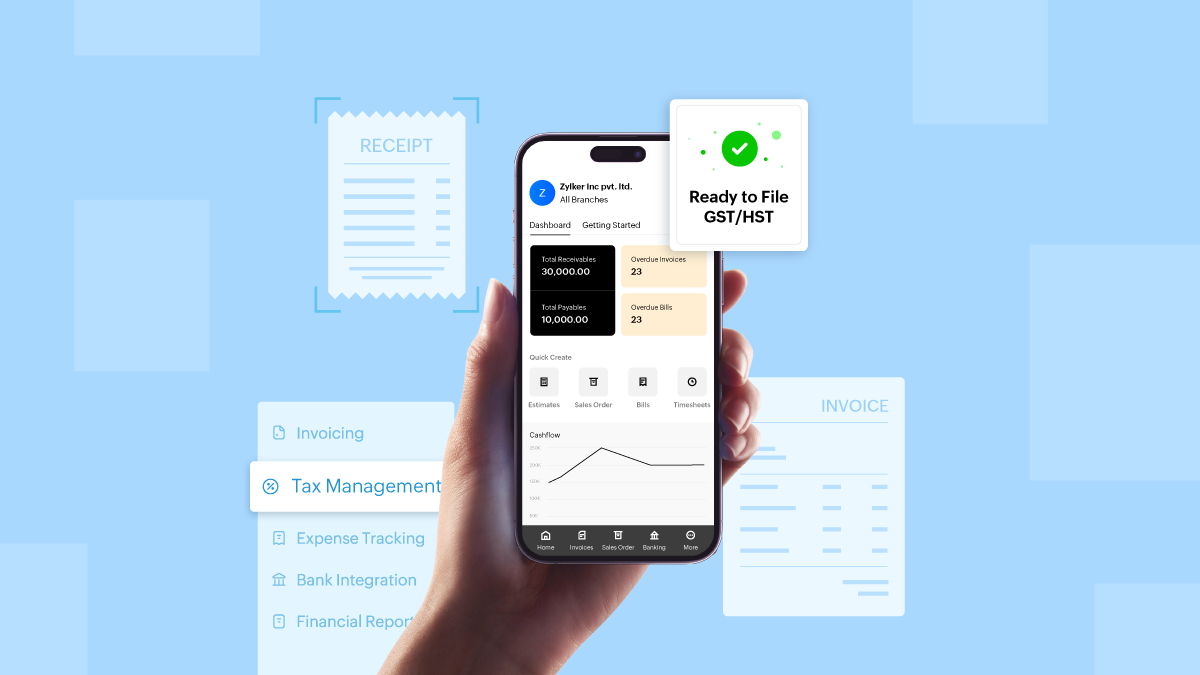
Many Canadian businesses use mobile-enabled platforms like Zoho Books to manage GST/HST while working away from a desk. Mobile invoicing, receipt capture, and real-time tax summaries help keep records aligned with daily activity.
The result isn’t just convenience; it’s fewer adjustments, clearer records, and less pressure when filing deadlines approach.
PST and RST don’t follow the same structure as GST/HST, and they aren’t managed the same way across Canada. For businesses operating in multiple provinces, this can create confusion—especially when tax treatment changes based on location, customer type, or product category. Having tax settings and customer location details captured accurately at the point of invoicing helps reduce misapplication and rework later.
When compliance becomes easier to manage
GST/HST compliance becomes easier to manage when it’s woven into everyday work. Invoices created accurately, expenses recorded early, and tax figures reviewed regularly all reduce the need for last-minute fixes.
Mobile accounting supports that rhythm. It keeps tax decisions closer to the moment work happens, which is often when they’re easiest to get right.
For Canadian businesses that spend more time moving than sitting at a desk, that alignment can make compliance feel far more manageable.