5 trade show booth ideas that actually attract visitors

Learn how to design booths that stop people, spark curiosity, and turn casual visitors into engaged conversations using proven exhibition psychology.

Ever been in a situation at a trade show when you look around and realize... nobody's stopping by your booth? People walking past like it's invisible. Some glance, some smile politely, but most drift toward the brighter, louder, somehow more interesting competitor across the aisle.

And it stings, because you didn't come unprepared. You spent weeks planning the booth setup, briefing your team, shipping materials across cities, and maybe even rehearsing demos. But the booth still isn't pulling people in the way you hoped.

That's the hard truth about trade shows: good booths don't win, memorable booths do. The ones that move, surprise, or spark curiosity among attendees. And that kind of impact doesn't come from chance; it comes from smart, intentional exhibition design rooted in psychology, flow, and human behavior.

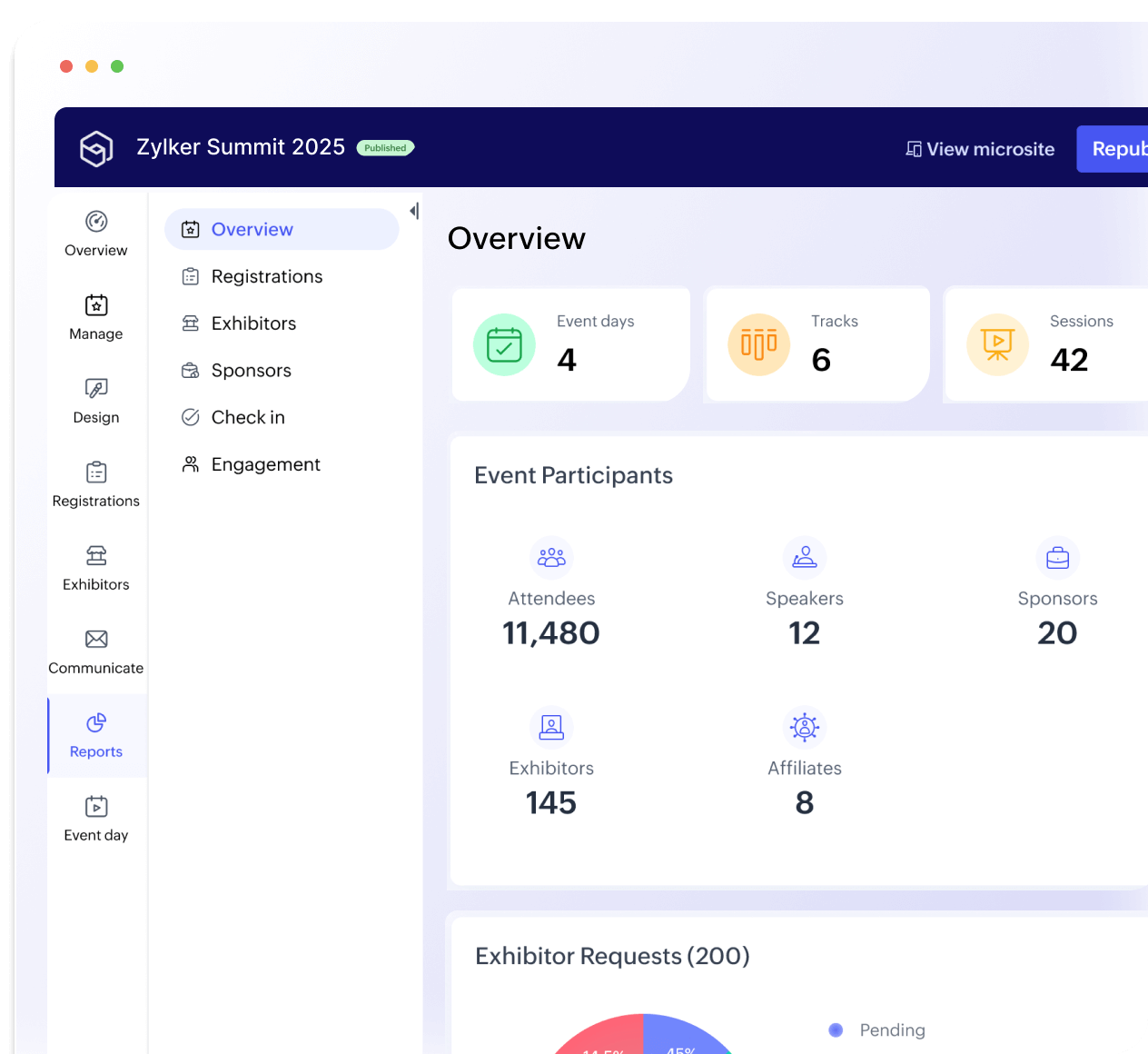
So let's go deep into trade show booth ideas that don't just "look nice," but actually work. Ideas that make attendees pause mid-walk, lean in, walk closer, and most importantly, start talking. And as we explore this, you'll also see where tools like Zoho Backstage support the kind of interactions modern booths need, both onsite and in virtual expo environments.

This isn't going to be surface-level, generic advice like "use bright colors." This is a full, detailed breakdown of what makes a booth engaging, memorable, and traffic-pulling in a real-world trade show environment.

Top trade show booth ideas

A practical guide to booth setups that stand out in crowded halls

Top 5 trade show booth ideas that drive engagement

If you want people to stop at your booth, remember it, and actually engage, you need ideas that feel intentional, not decorative. Below are refined, high-impact trade show booth ideas that are detailed, practical, and rooted in real attendee behavior, but without overwhelming you with length.

1. Add a live "micro-moment" that repeats throughout the day

Small, recurring experiences, like a quick teardown, a 3-minute insight demo, a "before/after" reveal, create natural energy around your booth. Movement draws people instinctively. When something happens every 10–15 minutes, your booth stays alive, and visitors develop a reason to pause and interact with your display. This is one of the simplest ways to boost engagement without increasing booth size or cost.

2. Use a tactile zone that encourages visitors to touch and explore

People remember what they touch and feel far more than what they simply see. A sample wall, a try-it-yourself corner, or a product they can assemble or test naturally increases dwell time and opportunities for discussions. Even software brands can use tactile props to turn workflows into physical interactions. Touch-based areas make your booth setup feel approachable and immediately more memorable.

3. Build a single, bold "anchor element" that triggers curiosity

Every great booth has one thing visitors notice instantly: a transparent display, a kinetic object, a large-scale model, or a screen with purposeful motion. This anchor doesn't need to be expensive; it needs to be distinctive. Place it strategically inside the booth so people walk in naturally to check it out.

4. Create a guided flow with simple visual or physical cues

Attendees move better when there's a clear path. Use angled structures, lighting, layout shapes, or even flooring texture to guide visitors from introduction → demo → conversation. A booth with a natural flow feels premium and intentional. It also gives your team more space to have structured, high-quality conversations instead of rushed exchanges at the aisle.

5. Design a moment worth photographing (without being cheesy)

Instead of typical selfie walls, create a visually striking installation tied to your brand story, something people want to photograph organically. This could be an oversized object, an illusion, a witty line, or an artful structure. When visitors take photos, your brand gets amplified without forcing branding into the center of the moment.
How to design a booth that stops visitors in their tracks?

A trade show floor is a sensory overload. Attendees walk over hundreds of booths in a single day, and spend just a few seconds deciding whether they should stop at a booth or keep walking. Those first few seconds matter more than anything you'll ever print, design, or rehearse.

Smart booth design is about guiding how the attendees spend those precious minutes. Not with gimmicks, but with intentional decisions about layout, visibility, sensory cues, and human movement.

Here are the foundational components that determine whether a booth becomes a magnet or a hallway decoration:

1. Start with a booth layout that guides behavior, not just traffic

The biggest mistake exhibitors make is treating the booth as a "display area" instead of a "flow space." But if you watch attendee behavior closely, you'll notice something interesting: people hesitate stepping into enclosed or unclear spaces.

A strong booth layout creates permission (psychological permission) for people to enter.

Here's how:

  • Keep the booth open from at least two sides

A booth that feels closed off creates friction. Attendees don't want to "commit" to stepping inside because it feels like stepping into someone's shop. But a booth that's open on two or three sides feels safe, accessible, and low-pressure.

This doesn't mean your booth needs to be "minimal." It simply needs entry points that are visible and inviting.

  • Use anchor elements to pull visitors deeper

In strong exhibition design, you want people to step inside, not just stand at the edge. You do this with anchors, which are elements placed at the back of the booth so people naturally move toward them.

Examples of anchors:

  • A demo station that has movement
  • A small hands-on product "island" visitors can interact with
  • A live presentation screen or "content moment" that visually pulls people inward

Every booth that performs well has something happening inside, not just "displayed up front."

  • Place the "conversation space" away from the booth edge

If your sales team stands right at the aisle line, it creates a psychological wall. Attendees feel like they're walking into a conversation, which triggers discomfort.

Instead:

  • Keep the staff positioned 3–5 feet inside the booth
  • Place conversation areas near anchor points
  • Let attendees take the first step into the space

That single shift alone increases conversion conversations dramatically, because attendees approach voluntarily rather than feeling approached.

2. Build a visual identity that people recognize in 1–2 seconds

Your booth has one job visually: be instantly recognizable, both up close and from 40 feet away. This isn't about "bright colors." It's about visibility strategy.

1. Prioritize high-mounted, readable overhead signage

The average trade show venue has booth signage clutter at eye level. So what you do above eye level becomes your advantage. High-mounted signage (10–14 feet up) can help improve visibility.

Make sure:

  • Your brand name is readable from a distance
  • Your value proposition is short, specific, and clear
  • Your fonts are thick, not thin
  • Your colors contrast with the environment

Thin fonts disappear under trade show lighting. Fancy serif fonts collapse under distance. Minimalism is not your friend here; clarity is.

2. Use one strong visual story, and not a collage of ideas

Multiple competing visuals confuse the eye. A single, bold, story-driven visual draws people in.

This could be:

  • A large, vivid hero image
  • A product in action
  • A bold, oversized illustration
  • A kinetic screen with motion tied to your brand

People don't notice details at first glance. They notice patterns, color blocks, and movement.

3. Use lighting strategically to elevate your booth experience

Lighting is very important for decoration and attention to architecture.

Most booth lighting is generic. But a targeted lighting scheme helps create hierarchy between your product, your demo area, and your signage. Lighting alone can make a mid-budget booth feel premium.

1. Light your product or demo first, not your walls

People follow brightness. A well-lit product pulls in more attention than a backlit wall. Hence, always take lighting very seriously as it will leave an impactful impression on the people who see it.

2. Use contrast to shape depth

Soft ambient lighting + focused accent lighting creates a layered environment that looks more intentional and less flat, and is the exact opposite of the "expo stall look." Always experiment with different types of lighting to find the right balance.

3. Integrate motion lighting sparingly

Motion attracts attention, but too much motion overwhelms. Use subtle light movement to highlight key areas without cheapening the booth. This will also help your booth stand out from other booths in the event.

How to create interactive experiences that make people stop and participate?

A trade show booth justifies its cost when attendees visit it and do something, not just see something and leave. This is where interactivity becomes your strongest competitive advantage.

But interactivity isn't about throwing in a touchscreen because everyone else is doing it. It's about building moments that help visitors feel involved, surprised, curious, or personally invested. Here are some ways to achieve meaningful interactivity:

1. Use product demonstrations that invite participation, not observation

The best trade show booths turn demos into small interactive "shows." Something is happening every few minutes. Something that generates a small crowd, which automatically attracts a bigger crowd.

Here's what a high-impact demo looks like.

The most important trait of a high-impact demo is that it has movement. Movement pulls attention instantly. Whether it's a machine operating, a product reacting, a screen animating, or a human demonstrating, movement beats static displays every time. The second most important trait is pacing. A good booth demo should last 3–6 minutes. Any longer, and you lose walk-in interest. Any shorter, and it doesn't feel substantial. And the third most important element is a storyline. Not "Here's our product," but:

  • Here's the problem
  • Here's what usually goes wrong
  • Here's the moment we fix it

That's how you turn a demo into a mini experience.

2. Introduce hands-on elements that trigger curiosity

People retain 80% of what they physically experience, versus only 30% of what they see. That's why hands-on booths outperform passive booths.

Examples:

  • A tactile sample station
  • A "try it yourself" kiosk
  • Micro-experiments
  • A live customization moment
  • Physical prototypes that visitors can manipulate

Hands-on experiences create anchored memories the same way childhood hands-on learning beats textbook learning.

3. Add micro-engagements that work even for fast-moving visitors

Not everyone will have time for a full conversation, but micro-moments can create interest spikes that bring people back later.

Examples of micro-engagements:

  • Quick polls (QR-based or screen-based)
  • 30-second product challenges
  • Interactive screens with scroll-short videos
  • Motion-triggered visuals
  • AR try-outs or virtual demos

Even a micro-engagement that lasts 10 seconds can change your booth's perception from "good" to "interesting."

How can you use technology to elevate your booth experience beyond decor?

Technology is no longer a "cool extra" for trade shows; it's the differentiator. Attendees expect interactivity, movement, responsiveness, and digital touchpoints that connect the physical booth setup with their personal experience.

And the best part? You don't need giant budgets to do this. You just need intentionality. Technology in exhibition design works when it solves a problem: helps people understand your product faster, lets them explore at their own pace, or gives them something they can't get at the other booths. Here are some ways to use tech that actually move the needle for visitor engagement:

1. Use screens strategically, not decoratively

The biggest newbie mistake: adding screens "just because everyone else is doing it."
But a screen with a random slideshow won't stop anyone. People ignore screens unless the content moves, teaches, or provokes curiosity.

Here's how to make digital screens actually work for your booth:

1. Use screens to simplify complex ideas

If your product is technical, complicated, or harder to explain in words, visual storytelling is your best friend. A 15–20 second animated loop showing transformation (before/after), workflows, or use cases helps attendees "get it" without waiting for a salesperson.

2. Create dynamic, motion-based triggers

Movement pulls the eye. Not chaotic motion, purposeful motion.

Here's what you can use:

  • A screen that reveals problems visually
  • A slow pan over product internals
  • A subtle motion graphic that hints at function

Dynamic elements get 2–3 times more dwell time compared to static content.

3. Make screens accessible from the aisle

Place at least one screen facing outward at aisle height, as screens hidden inside the booth lose a lot of visibility and often prove to be very ineffective.

2. Use augmented reality (AR) or virtual showcases to expand your booth's capabilities

Many exhibitors struggle with one major limitation: space. Your products are too large, too heavy, too technical, or too many to display. This is where AR becomes a real asset.

With AR:

  • Visitors can explore product variants
  • View exploded views
  • Rotate or zoom into parts
  • Understand features interactively

You're basically giving them a "digital hands-on" experience without physical clutter.

More importantly, AR gives your booth a sense of depth that other booths can't replicate.

And when you combine AR with a unified digital environment like Zoho Backstage, you can continue the experience online through virtual expo management features, letting visitors revisit demos, download brochures, and explore catalogs even after the trade show day ends.

That's how you stretch the booth's impact far beyond the physical floor.

3. Use lighting tech to create emotional ambience

Lighting tech is one of the most underrated tools in exhibition design. When used right, lighting gives your booth an emotional temperature, a feeling visitors get the moment they step in.

1. Use warm lighting for trust-based brands

Warm, soft, ambient lighting creates comfort. Perfect for industries like healthcare, wellness, education, or consulting.

2. Use crisp white lighting for innovation-driven brands

Crisp, bright lighting communicates precision, tech-forward thinking, and cleanliness, and is ideal for SaaS, engineering, manufacturing, and digital products.

3. Add subtle color accents for zones

Color temperature can guide navigation. For example:

  • Blue highlights for the demo zone
  • Soft amber for conversation corners
  • Neutral white for product displays

Color cues help attendees understand the booth without verbal instructions, making your space more intuitive and fluid.

Build your next trade show booth with a smarter engagement strategy with Zoho Backstage

A booth is more than a regular space. It's your brand's first impression, story, and moment.

And when you design it with intention, with psychology, technology, and real attendee behavior in mind, your booth stops being a structure and becomes an experience people talk about long after the hall lights dim down.

If you want to take everything you've learned here and actually turn it into a booth that drives traffic, conversations, and leads, Zoho Backstage gives you the environment to make those ideas real.

From exhibitor tools and floor-plan management to lead capture, analytics, and virtual booth extensions, it's built to support every moment of your trade show journey.

FAQs

Use AR only when it helps explain complex products or experiences that can't be shown physically in a simple way.

A good rule is one staff member for every 50–60 square feet to manage visitors efficiently without overcrowding.

Start planning at least 10–12 weeks in advance to allow enough time for design, approvals, and setup.

Run short demos or timed activities and announce them through the event app to bring in attendees.

Yes. Strong messaging, smart lighting, and one standout interactive element can make a small booth highly effective.