Hybrid trade shows: The complete playbook from planning to post-event

Hybrid trade shows can 3x your attendance and 2x your lead capture. Here's exactly how to plan, run, and profit from one.

Trade shows are often limited by who can actually show up. Your audience might be global, but travel costs, time, and scheduling conflicts mean a lot of the right people don't make it in person. At the same time, there's more pressure than ever to prove real ROI, not just how many people walked the floor.

Hybrid formats help close that gap. You still have the in-person experience, but you're not relying on just that. People can join remotely, engagement isn't tied to a few days, and you have more chances to connect with your audience.

Take the Eco Expo Asia tradeshow. It went hybrid in 2021 and continues to run an extended online matchmaking platform, giving exhibitors more options to connect with international buyers before and after the show. Others, like Automechanika Shanghai, run hybrid programs alongside the main physical exhibition to improve reach. These are just some variations of hybrid trade shows.

In this article, we cover the different hybrid trade show formats, what goes into planning one, and how to keep both audiences engaged throughout.

How to host a hybrid trade show

A guide to hosting hybrid trade shows: Same experience, bigger reach

What makes a trade show truly hybrid?

A hybrid trade show runs two parallel experiences. There's a physical venue with booths, live demos, and in-person networking, and a virtual platform where remote attendees get the same experience through live streams, virtual booths, and breakout rooms. Neither experience is secondary, and both audiences reach the same content and contacts, just through different channels.

We all understand the concept of a hybrid event, but executing it right is a whole different story. Often, you stream the sessions but forget about the booths, networking, and Q&A. So, virtual attendees end up getting half the trade show. But virtual attendees, in fact, can be your larger attendees.

At Automechanika Shanghai, online visits outnumbered physical attendance nearly 4 to 1.

For a hybrid trade show to work, every attendee needs equal access to the content, exhibitors, and networking. Without a dedicated strategy to drive booth discovery, half your exhibitors are invisible to half your audience.

Why host hybrid trade shows? The business case

Adding a virtual component to your trade show means more complexity, more staff, and more technology to manage. But the return on that investment is hard to argue with.

Here's what you get with hybrid tradeshows:

Better attendance and reach

A hybrid model can realistically draw 2–3x the attendance of a physical-only show, and virtual attendees reduce venue pressure. You don't need as much floor space—cost savings you can redirect toward production quality or platform investment.

Revenue compounds too. You're monetizing two audiences instead of one, through ticket sales, virtual add-ons, and sponsorships that span both components. In fact, according to a survey by ElectroIQ, 80% of event planners think hybrid events offer greater reach and engagement. 61% of them also found hybrid events more cost-effective than in-person ones.

More value for exhibitors and sponsors

At a traditional trade show, an exhibitor's reach is capped by foot traffic and show hours. Hybrid removes both constraints. Virtual booths remain accessible long after the physical show closes, and exhibitors capture leads from remote audiences they'd never otherwise reach. For sponsors, visibility extends beyond on-site banners to include livestream mentions, digital placements, and ads in the event app. More importantly, these touchpoints continue to deliver value beyond the event itself—something organizers are increasingly prioritizing as they seek to extend event ROI over time.

Your tradeshow becomes more sustainable

80% of event attendees are ready to pay more for sustainable event options, and hybrid trade shows make that case naturally. Fewer people travelling means a smaller carbon footprint by default. Attendees are increasingly treating event sustainability as a participation criterion rather than a bonus.

Pairing virtual attendance with a green venue compounds the story in a way that's hard to ignore when pitching the show to sponsors and exhibitors.

The two hybrid trade show formats, and when to use each

The event format you choose comes down to one question: do both audiences need to be in the same moment, or can the experiences be separated in time?

Synchronous hybrid trade shows

Here, you run in-person and virtual simultaneously. Both audiences access the same sessions, exhibitors, and networking in real time, with genuine cross-audience interaction.

It's a demanding format as you need dedicated moderators and staff for each audience, reliable event production, and an event platform that can handle the load. The payoff is immediacy, energy, and the highest possible live reach.

Asynchronous hybrid trade shows

Here, you split the two experiences across separate days. You'll be running the in-person show first, then the virtual component a few days to a couple of weeks later, while the content is still fresh.

Each audience gets a purpose-built experience rather than a compromised version of the other's. The trade-off is that you're producing two events, not one, which means two budgets, two production runs, and twice the planning.

Adobe, for example, has a 1-day online "preconference" before they host the in-person event over the next two days.

So how do you decide which hybrid show format to use for your event? Here is the decision matrix to help you pick the right one:

FactorGo synchronous if…Go asynchronous if…
BudgetYou have the budget for a full hybrid production in one goYou'd rather spread costs across two leaner productions
TeamYou have dedicated staff for both audiences simultaneouslyYour team is better suited to focusing on one audience at a time
ExhibitorsYour exhibitors are experienced with hybridYour exhibitors are new to virtual events and need dedicated attention
GoalsLive energy and cross-audience interaction matterTailored experiences and content shelf life matter more
Risk toleranceYou're confident in your tech and production setupYou want to reduce the risk of either audience getting a poor experience

Understanding which format to use for your hybrid trade show ultimately depends on your event planning, available resources, and stakeholder preferences.

Hybrid trade show planning: What to get right before the doors open

In this section, we focus on planning a synchronous hybrid trade show (where both audiences are live at the same time) because that's where most of the complexity lives. If you're running an asynchronous show, most of this still applies, and we'll highlight where the approach differs.

Goals, audience segmentation, and registration

Start with specific event goals. Are you there to generate leads, build brand awareness, give sponsors visibility, or establish thought leadership? The answer shapes every decision that follows, including event content format, session structure, and how you brief your exhibitors.

Once your goals are clear, segment your audiences:

  • In-person attendees come for human connection, live product demos, and the energy of the show floor.
  • Virtual attendees come for flexibility, easy access to content, and the ability to engage on their own terms.

Those are different motivations, and your registration flow should reflect that with distinct pricing and a clear value proposition for each. We also suggest you build in the ability to switch between virtual and in-person tickets, too, which gives attendees a Plan B when circumstances shift.

💡When going async: Registration needs to clearly communicate that the two experiences happen at different times, and what each audience gets that the other doesn't. Then, spell out the value proposition for each audience type, because, unlike with synchronous hybrid events, here you can't give them the same experience.

Building your team

The staffing mistake that derails more hybrid trade shows than any technical failure is assuming the same people can manage both audiences. They can't. Assign separate teams from the start.

Your virtual team needs at a minimum:

  • A dedicated moderator monitoring chat and answering queries in real time
  • One person who is solely responsible for streaming and camera work
  • IT support available throughout, not just on standby

Train speakers to actively address both audiences, too. Polls, live Q&A, and chat prompts are what make virtual attendees feel like participants rather than viewers.

💡Host session rehearsals: Many hybrid event platforms—including Zoho Backstage—come with rehearsal options. Make use of them. They give speakers time to get comfortable addressing two audiences at once, work out camera angles, test audio, and catch issues that are embarrassing to fix mid-session.

Planning logistics: Picking your venue and platform

With your team structure in place, the next decisions are about event logistics and infrastructure. When evaluating venues, give the internet and AV infrastructure the same weight as location, capacity, and layout.

For the hybrid trade show platform, we suggest that you consider:

  • Hybrid-specific features: Look for virtual booths with built-in lead capture, breakout rooms, live chat, Q&A, matchmaking, session recording, and a real-time analytics dashboard. If the platform wasn't built for trade shows, these will feel like afterthoughts.
  • Performance: Can it handle your full attendee load without slowing down? A platform that struggles at peak could take down the virtual experience at exactly the moment it matters most.
  • Native integrations: It should connect cleanly with your CRM, email platform, and analytics tools. Data that has to be manually exported and reconciled after the show costs your exhibitors and sponsors time they don't have.
  • Data security: GDPR compliance and strong data encryption are non-negotiable. You're collecting attendee and lead data across two formats, and your exhibitors and sponsors need to trust that it's handled properly.
  • Ease of use: If attendees need a guide to navigate it, you'll lose them before the show starts. The same goes for exhibitors managing their virtual booths. The platform should be intuitive and inclusive for everyone, regardless of technical ability.

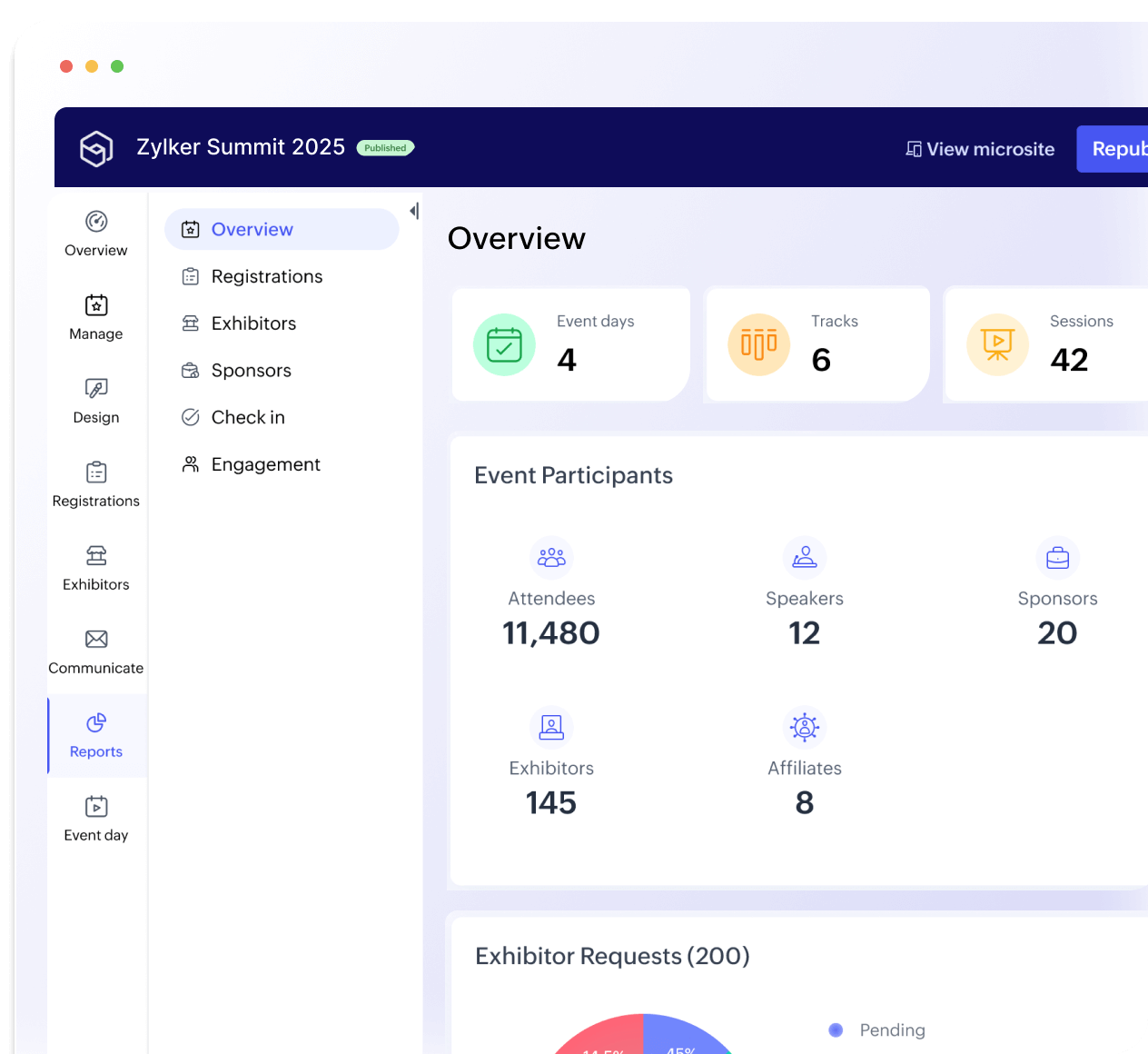
Hybrid trade show platforms also come with trade show-specific features built for each experience. Zoho Backstage, for example, offers a floor-map designer for in-person booths and a virtual booth designer for remote exhibitors. This lets you set up and manage both components from one place without switching between tools.

💡When going async: Set up two separate agendas and booth environments on your platform — one for the in-person show, one for the virtual. They run at different times and serve different audiences, so they need to be built and managed independently from the start.

Exhibitor and sponsor setup

Every physical exhibitor needs a virtual booth equivalent. If it doesn't exist online, that exhibitor doesn't exist for your virtual audience. Give exhibitors customizable booths with the tools they need: product displays, video presentations, downloadable brochures, live chat with booth reps, and lead capture. For exhibitors new to the hybrid setting, assign a point of contact from your team to walk them through the setup and answer questions promptly.

Lead capture also runs on two tracks: QR scanning for in-person booth visits and booth visits and meetings for virtual booths. Both feeds need to land in one unified system. Exhibitors shouldn't have to reconcile two separate lead lists.

A good hybrid trade show platform handles this automatically by centralizing data from the lead capture app and virtual platform. So exhibitors leave with one complete picture instead of two incomplete ones.

For sponsors, design tiered packages that span both components:

  • A base tier might cover logo placement on the virtual platform and a physical banner at the venue.
  • A mid-tier adds a sponsored session that's livestreamed to both audiences.
  • A top tier gives sponsors a branded virtual booth, direct lead data, and a livestreamed demo slot.

The more tangible the value at each level, the easier the conversation.

Keeping both audiences (and exhibitors) equally engaged

Getting both audiences to show up is the easier part. Keeping them equally engaged throughout is where most hybrid trade shows lose ground. Usually, the virtual experience is built around what is convenient to stream rather than what virtual attendees actually need. Here's how event teams can capitalize on the opportunity and make the event valuable for all stakeholders- attendees and exhibitors alike.

Design two experiences, not one broadcast

Every feature that exists in-person needs a virtual equivalent. Building the virtual experience around "how do we stream this?" misses the point. The better question is: what does a virtual attendee need at this moment?

Here's a quick cheatsheet to get started:

In-person experience (Venue)Hybrid / virtual equivalent (Platform)
Physical networking loungeDigital breakout room or themed networking room
In-person product demoVirtual booth with a live representative
Speed networking on the show floorAI-powered matchmaking and scheduled 1:1 video meetings
Expo hall exhibitor boothVirtual exhibitor booth with videos and chat
Booth staff conversationsOptions to book meetings with booth reps
Roundtable discussionSmall-group video discussion rooms
VIP networking receptionInvite-only virtual networking session
Lead badge scanning at boothsDigital lead capture and contact exchange
Business card exchangeProfile connection and contact export
Wayfinding signage and floor mapsInteractive virtual expo map
Sponsored lounge or hospitality areaBranded virtual networking room

Exclusive virtual content helps too. Behind-the-scenes access, virtual-only sessions, or early access to recordings give online attendees a reason to show up that isn't just "it's cheaper than flying."

Double down on real-time engagement tools

The lower you set the barrier to participation, the more engaged both audiences become. A shared event app is what makes that possible across both formats. Chat is the baseline: it's how virtual attendees network with each other, connect with in-person attendees, and participate in sessions without waiting for a formal Q&A slot.

Build on that with live polls, Q&A, and surveys that both audiences can respond to at the same time. Finally, add gamification. Put both audiences on the same leaderboard, and virtual attendees stop watching the show and start competing.

💡When going async: Your virtual show needs its own engagement strategy built around the content your in-person audience already experienced — live Q&As with speakers, networking sessions, and discussions that give virtual attendees something to react to, not just watch.

Show exhibitors how to drive traffic from both formats

Your exhibitors know how to work a physical booth. Running a virtual one and juggling both together requires a different skill set. So brief them on how to go about it:

  • Assign separate staff for each format — the person managing the virtual booth shouldn't also be running the physical one to avoid distractions and missed interactions.
  • Schedule live demos at fixed times and promote them on the event app so both audiences can plan around them.
  • Offer exclusive content through the virtual booth — case studies, product specs, demo recordings—that gives virtual attendees a reason to visit.
  • Use session chats and the social wall to drive traffic to the virtual booth during the show.
  • Keep response times fast on both sides — a virtual attendee who doesn't get a response moves on in seconds.

💡 Pro tip: Put all of this into an exhibitor manual and share it well before the show opens. The more prepared your exhibitors are, the better the experience for both audiences — and the stronger your lead numbers at the end.

Run hybrid tradeshows at scale with Zoho Backstage

Running a hybrid trade show means managing two audiences, two sets of exhibitors, and two streams of data simultaneously. The complexity compounds quickly, and the tools you use either absorb it or add to it.

Zoho Backstage is built for exactly this. From registration and floor map design to virtual booths, lead capture, and post-show analytics, everything runs on one platform. That matters most on show day, when you're managing two audiences at once, and there's no time to fix what the planning got wrong.

Sign up for free and see for yourself how Zoho Backstage handles both sides of your next hybrid trade show.

FAQ

The core stack includes a hybrid event platform, professional AV equipment (cameras, microphones, lighting), reliable high-speed internet with a backup, and a mobile event app. Some all-in-one event platforms (like Zoho Backstage) cover most of it in one place and partner with event and tech agencies to help with your other requirements, such as printing and AV.

Start by tracking registrations versus actual attendance across both components, then delve deeper into booth visits, lead quality, and total revenue relative to costs. The virtual side actually makes this easier, because the data is far more granular than anything you'd get from a physical-only show.

In-person, it's badge scanning, QR codes, and RFID. Virtually, it's booth visits, content downloads, form fills, and live chat interactions. The real win is when both streams feed into one place. The experience depends on your event tech platform, so choose wisely.

The most common one is not giving every physical exhibitor a virtual booth — if it doesn't exist online, that exhibitor simply doesn't exist for half your audience. The other is splitting physical and virtual lead data across separate systems, which makes post-show follow-up for exhibitors messier than it needs to be.