The only event venue management checklist you need in 2026
Here's a comprehensive fail-proof checklist to help you successfully handle everything related to your event venue, from locations to setup and activities.
Transforming an empty event space into a full-fledged venue arrangement is no mean feat. Event planning teams spend months perfecting every single aspect from AV setups, gamified activities to marketing collaterals and more, all within budget and bandwidth crunches.
However, come event day, they're often left firefighting with some missed detail or loose ends they'd missed out on.
That's because location, ambience, and the overall attendee experience make the biggest impression. To get these elements right, teams need a structured framework that ensures everything works in sync.This where a clear, structured event venue checklist comes in to help teams stay organized, track dependencies, and keep every moving part on schedule.
As we move into 2026, hybrid and in-person events are seeing a strong resurgence. Industry experts even call in-person gatherings a "business superpower," driving deeper connections and more memorable experiences.
As a result, event venue management has become more than an operational detail—it's a direct driver of event success and brand perception.
Whether you're planning to host your upcoming event and have great venue ideas in mind, this guide and the smart check-list helps you make the best of it.
A beginner's guide to event venue management checklist
Why do I need a checklist to manage my event venue?
A structured event venue management checklist goes a long way above basic task management. An actionable, itemized checklist helps you spend budget smartly, curate great activities, and orchestrate a seamless attendee experience.
As an event manager, you might be contending across various choices when it comes to event venue selection and management---from conference rooms to convention centers, it is no easy task to find an event venue that fits your overall event vision while still staying under budget constraints.
Every one of these venues have different policies, pricing, compliance factors and come with a host of other intricacies.
Your event venue management checklist is what ties all these specifics together, by:
Creating a selection, logistics, and spending strategy
Bringing all stakeholders, from internal to external stakeholders, to a single view
Allocating work efficiently across the event planning team
Ensuring event logistics are handled without last-minute delays or issues
Above all, a detailed event venue management checklist helps you tie back all operations to the net ROI of the event, by assigning tangible value to every single action.
With event planning, teams always start about 6-9 months in advance for larger events. Teams that use a detailed checklist from the start save heavily on vendor coordination time, avoid overspending, and bring the original vision to life much more easily.
The 5-step event venue planning master checklist for success at every stage
Here's a glimpse of a checklist that will help you plan such corporate events out with ease and efficiency. We'll be linking every stage of the checklist with an end goal---to help you identify wins and tailor your custom checklist to them.
Step 1: Venue discovery and shortlisting
Goal: Select an event venue that's the best fit for event objectives, audience profile, and brand perception.
We split this into 2 parts---one on how to decide on the perfect venue type for your event, and another on how to practically shortlist event venues to find the best option.
How to decide on a venue for your corporate event?
If you're holding a mid-sized or slightly large scale event with more than 200 attendees, chances are you're considering many venues of different sizes and ambience.
You'll be drafting an RFP (Request for Proposals) to send out to venue hosts and vendors to collect and select from responses.
Here's what you can check at this stage:
Event format: It suits your model (in-person, hybrid, virtual-to-hybrid)
Location: Conveniently accessible for attendees and hosts---both local as well as arrivals from other region
Ambience: It is matches the goals, formality and structure of the event (banquet halls for networking vs resorts for company getaways)
Physical space: It can accommodate all attendees, event teams and external staff (+15% surplus)
Facilities: The physical layout of the event can support all planned activities
Compliance: It has all certifications, licences, and meets needed compliance standards
How to shortlist the right venue?
Create a venue shortlist matrix based on the below metrics, and rate them from 1–5.
Venue list
Capacity & layout flexibility
Facilities and amenities
Brand & alignment
Pricing
Total score (out of 20)
Venue 1
Venue 2
Venue 3
Venue 4
Practically, venue selection is often a trade-off triangle between location, capacity, and cost. A venue that scores high on amenities may come with a higher pricing range, for example.
The best event venue, finally, is one that amplifies your event's intent the most.
Step 2: Negotiation, contracts, and compliance
Goal: Finalize and secure your event venue, handle payments and legal compliance
What to check on the answers to your RFP (Request for Proposal)?
Fun fact---there's an anecdote about the band Van Halen, who famously included a "no brown M&Ms" clause in their concert contracts to see if venue managers carefully read and followed their detailed technical and safety requirements. If venue hosts missed out on this, there wouldn't be a performance.
It's a clever move, but also shows us how important the hidden, detailed RFP clauses are---so check if your venue hosts are able to adhere to that standard of detail.
Availability: Direct confirmation of location availability on your exact event timeline
Basic amenities: Check on availability of sufficient rest spaces, green rooms, dining areas, first aid provisions etc.,
Detailed facilities: Run through availability of requirements like AV setups, electricity, advanced Wi-Fi connectivity etc.,
Pricing: Clarify base pricing and other costs (service fees, union labor, insurance, taxes).
Permits: Ensure fire, safety, and public event permits are covered. This is a mandatory compliance procedure.
Additional licenses: If you're having special activities and customizations, check for licensing arrangements
Vendors: Venues often come with basic staffing options. Check on staff hiring options.
Terms and conditions: Investigate cancellation terms and risk contingencies.
The best venues offer you a lot of flexibility; they give you a free hand in setting up creative stage decor and allow you to design rich audience experiences. They also come prepared for last-minute additions, equipped with basics like additional parking and seats if needed.
Before final confirmations---what to do here?
Direct negotiations: Have your event planning team conduct multiple rounds of one-on-one discussions with venue hosts, to ensure negotiations are clear and transparent.
Walkthroughs: You and your team need to take 1-2 guided and unguided tours of the venue to understand the layout and offerings better.
Peer reviews: Get observations from peers, review platforms and other external sources to review the location carefully and understand how the event experience has been with past events.
These go above regular checks to give you a tangible look and feel of the event space.
Step 3: Pre-event venue preparation
Goal: Translate your event vision into the physical layout by curating all arrangements and finalizing the set-up.
Before we jump into the next part of the checklist, it's important for us to keep in mind the exact format (in-person, hybrid, virtual) and requirements of the event.
Planning a formal partner's dinner is quite different from planning a SaaS user group conference---they have different scope, objectives, audience and hence, venues.
A formal dinner of 20-50 attendees at maximum happens within a conference hall of a hotel---it might need basic technical and AV setup, but heavy branding, gifting and transportation details. A SaaS user group event, on the other hand, is much larger in scale---it brings in greater attendee volumes, requiring multiple technical and electrical setups and detailed logistics efforts.
Let's keep this in mind through the following items:
Technical requirements: Confirm power, lighting, and AV infrastructure with proper safety checks
Connectivity: Test bandwidth and Wi-Fi coverage---especially if you're streaming. The best venues often provide best-in-class connectivity.
Space: Reserve green rooms, breakout rooms, and backstage areas.
Accessibility: Confirm accessibility (ramps, lifts, inclusive washrooms). Not just their availability, but actual usability by getting people of different needs to test them out.
Staff spaces: Coordinate with cleaning, F&B (Food and Beverage), decoration and other teams for load-in schedules.
Marketing collaterals: Ensure all banners, standees, digital backdrops, swag bags and all other marketing collaterals are set in place across the venue.
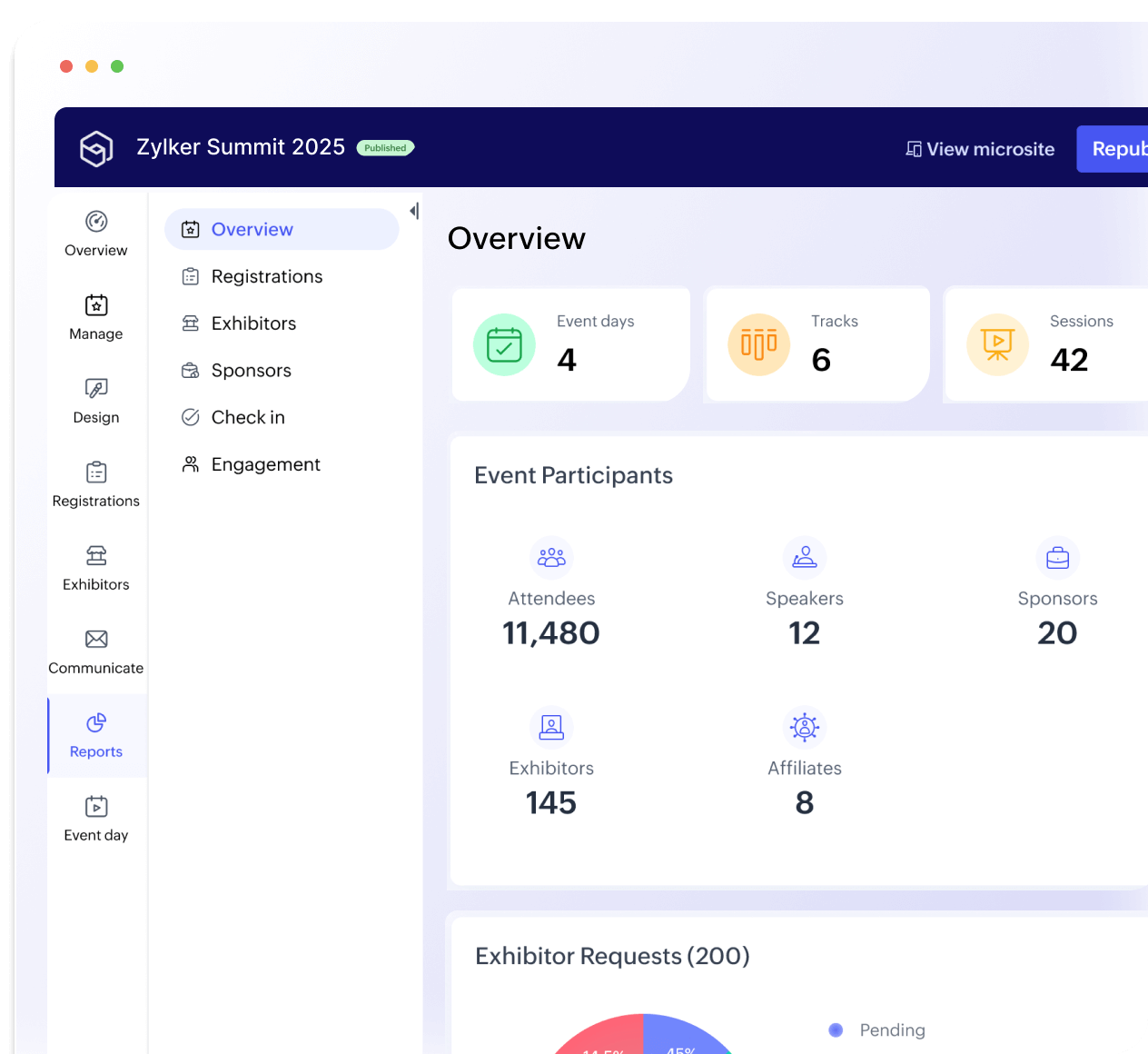
Managing all the elements of an event venue may sound overwhelming, but an event planning software like Zoho Backstage could make it easier. With features like an organizer mobile app, event managers can tackle vital elements like ticketing, attendee management and smart seating with ease and efficiency.
Step 4: Event-day operations
Goal: Maintain real-time control across attendee flows and event activities from start to finish.
Your venue should be readied for both expected and contingency situations by the time the day of the event rolls up. Event-day logistics often have event teams knee-deep into ground level tasks.
That's precisely why you need a checklist---since it helps organizers track the larger movements within the venue, and manage operations easily.
On the event day, what kind of teams should I have assembled?
A master event organizer crew
An exclusive host team to tend to attendees
SPOCs to coordinate with vendors and staff
Crisis response squad
Support staff
Specific owners for different tasks means that you'll have smartly delegated the heavy work---which you can track using a dedicated organizer mobile app from your event planning platform. This is an important factor that helps determine your overall attendee satisfaction---streamlined event venue logistics means better experiences, and hence, better NPS (Net Promoter Score) outcomes.
Check on these about 24 hours before your audience arrives.
Vendors: Have quick cadences with all external vendors to confirm their operations
Security: Run final walkthroughs on exit routes, fire equipment, first-aid points etc.,
Navigation: Assign branded signs for entry, kiosks, stalls, activity centers
Technical tests: Conduct AV, connectivity, digital and other tests to ensure smooth technical setup
Streaming setups: In the case of hybrid or virtual events, check if all attendees are able to access the latest, working version of the streaming software.
Crisis response: Designate a crisis protocol team (communication tree + incident log).
Managing your attendees at the event venue
Arrivals: Provide valet parking services, or facilitate smooth parking with dedicated spaces. Arrange shuttle services for attendees travelling longer distances.
Check-in experience: Deploy digital check-in (QR codes, badge printing) for smooth flows
Badging: The same event management software can help you with badging attendees as well
Navigation: Use a mobile app to help attendees navigate the event space with ease
Step 5. Post-event deconstruction and analysis
Goal: Close the loop on financials, feedback, and final operations.
When done right, post-event reconciliation and insight capture results in about 10–15% cost recovery and helps forecast budgets for future events. That's where your event planning checklist comes in handy---so you can close the loop across vendors, stakeholders and vacate the venue at the stipulated time.
Payments: Audit invoices, reconcile advance payments, and approve vendor ratings
Waste disposal: Conduct waste disposal and sustainability reviews
Feedback: Gather attendee and sponsor feedback
Documentation: Document venue performance for future shortlists
Digitizing your event venue management checklist
It's important to create your event venue handling checklist as a digital, AI-assisted task list---to ensure your checklist functions robustly under changes and movement across stakeholders.
Using digitized planning can help you:
Provide easy and instant access to your overall plan to all authorized members
Track and take control of tasks across stakeholders
Make instant, real-time updates to your plan anytime, anywhere
Add a layer of security and authorization to your planning
View and analyze all your event metrics in one place to understand ROI
Let's explore the power of digitized venue operations management with an example close to home. At Zoho, we've had the pleasure of hosting our flagship event Zoholics across 30+ countries back-and-forth yearly. We've worked with diverse venues across multiple infrastructural settings, vendor lists and region-level policies for our events. Here's a glimpse from Zoholics UK 2025
From the start of the planning process to the final wrap-up, every event demands massive coordination and vendor involvement. This is where technology like event planning software helps us move fast without losing control---imagine our team wrapping up the event in London while our procurement team in a different city is already closing invoices, and preparing for the next event's items.
That's the power of digitized venue management. When done right, your event venue checklist helps you flexibly manage tasks and arrangements across venue operations for multiple events seamlessly.
Smart event venue management with Zoho Backstage
An event venue checklist can help you streamline your event venue management across event types, formats and objectives.
It helps you tie back actions to outcomes, structure your activities from start-to-finish, and optimize for speed and clarity. An event venue checklist goes beyond basic arrangements---it taps into everything from logistics and finances to attendee experiences and outcomes. Using an event management software like Zoho Backstage helps you create the best possible version of your checklist, to help you regulate venue management optimally and achieve the best possible ROI from your event.
Ideally, at least 4–6 months before the event. Larger trade shows or multi-day corporate conferences may need up to a year of lead time for contracts, compliance, and vendor coordination. The earlier you begin, the more negotiating power and creative flexibility you'll have.
If your venue setup ran on schedule, guests had smooth check-ins and navigation, and you stayed within 10% of your budget, that's a clear operational win. Post-event analytics from tools like Zoho Backstage can make this measurement easy. Track key metrics on-time execution, attendee satisfaction, and cost-to-experience ratio for calculating event ROI.
Always test for contingencies. Check Wi-Fi strength in breakout areas, lighting at different times of day, sound bleed between rooms, and emergency exits. These are details that often slip past RFPs but can make or break the attendee experience.