Event SEO: What works in an AI-first organic search world
Search is changing with AI, but SEO is still important and relevant. This guide shares seven ways to boost your event's visibility and innovative SEO moves that help the right audience find your event organically.
Marketers are worried about the future led by AI. The 2026 State of SEO Report from Search Engine Journal shares that 77.9% of marketers fear AI-generated answers will reduce website clicks, one of their top concerns. With zero-click results, AI Overviews, and featured snippets, more people get answers without visiting your site or your social media pages.
From an SEO perspective, event searches are much more specific than those for e-commerce, SaaS, or services, where there are hundreds of brands and products. For example, a would-be attendee searching for something like "tech conferences in Austin 2026" wants 5 options, not 100.
And the fundamentals that earn these placements (strong content, clear information, strategic optimization) are precisely what convert browsers into attendees. This guide covers how SEO is evolving with AI and seven practical strategies to maximize your event's visibility and drive real attendance.
SEO strategies to improve search visibility for your events
How event search is evolving—and why SEO still matters
Search is no longer just about ranking on Google's results page. According to Wix Studio, in August 2025, AI search users grew 2.91% month-over-month (about 55 million users) while Google users decreased by 0.01%. At Google's scale, even this marginal movement matters. The contrast points to a shift in how people search, discover, and make decisions online.
A year ago, there were 10 Google users for every AI search user. Now, the ratio is 4.4 to 1.
In one year, unique visitors to AI search platforms doubled from 338 million to 743 million, while Google's traffic has stayed about the same as earlier. Because of this shift, there are now two new areas to focus on for optimization:
Answer Engine Optimization (AEO), where you work to get featured in direct answers—Google's AI Overviews, featured snippets, etc.
Generative Engine Optimization (GEO), where you target AI platforms like ChatGPT, Perplexity, Gemini, and Claude. When these tools generate responses, you want your event cited in the proper context.
The basics of event SEO are still the same: clear information, structured data, and strong content. But now you need to think beyond Google and other search engines you may be targeting, and include AI search in your SEO strategy.
Why SEO is the foundation of AI search
The same event features that help you rank on Google also help you get mentioned by AI tools. These systems are built to identify quality signals, such as clear structure, trusted sources, and strong backlinks, just as search engines do.
Structured data, such as event schema markup, tells search engines and AI platforms exactly what your event is, when it takes place, and where it happens:
Google uses it to generate rich results in the Event Pack
ChatGPT uses it to extract accurate details when recommending events
So though AI systems evolve quickly, they're still trained on the web. And when you optimize for search engines, you're also optimizing for AI visibility.
Why SEO matters for event promotion in 2026
Event SEO helps you promote your event to people actively searching for something similar, build lasting visibility, and create credibility that paid ads can't match. Here are some reasons to invest in SEO:
Organic discovery when intent is high
When someone searches "sustainability conferences in Seattle June 2026," they're not browsing—they're hunting for an event with a specific goal- networking, brand awareness, product promotion, knowledge sharing, and so on. This is bottom-of-funnel traffic: people who know what they want from an event and are ready to make a decision.
Paid ads can reach this audience, but you're competing with every other advertiser—and paying for every click, which decreases your ROI. Event SEO, on the other hand, puts your event in front of high-intent searchers organically, right at the moment they're looking for it, with focused targeting and offering prospects what they are looking for.
Sustainable visibility without continuous spend
Paid channels require continuous investment to maintain visibility—pause your spend, and traffic disappears. SEO works differently. Once your event page ranks well, it continues attracting visitors without ongoing ad spend. For recurring event series, this visibility compounding effect becomes even more valuable, making event SEO a long-term acquisition asset rather than a short-term expense.
This is because your last year's optimized content feeds this year's visibility. Reviews, backlinks, and domain authority accumulate over time. Which means your initial investment in SEO pays dividends across multiple event cycles.
Competing beyond your existing audience
Your email list and social followers are finite. They're also already aware of you, limiting your reach. SEO helps you break you out of that echo chamber. It reaches people who've never heard of your brand or your event but are searching for precisely what you offer: different demographics, different markets, different industries—all discoverable through search.
This is how you reach people outside your existing audience. Someone in Austin searching for "tech leadership events" has no idea your Boston conference exists until Google Search puts it in front of them.
Trust and credibility through rankings
First-page rankings aren't just about visibility—they're trustproof. When your event appears organically at the top of search results, it signals legitimacy. Users trust Google's algorithm as a filter for quality and authority. Research also shows that the top three links get 54.4% of all clicks.
But even beyond clicks, being ranked highly establishes credibility. It tells potential attendees: this event is legitimate, established, and worth considering. Paid ads and sponsored search results can't replicate that earned trust.
Event SEO: 7 best practices for event planners
These strategies cover the full SEO marketing lifecycle for events—from planning through post-event. Some are foundational, others are tactical, and a few require ongoing attention. You can start where it makes the most sense for your event.
1. Master event-specific keyword research
Keyword research for events isn't the same as keyword research for products or services. You're dealing with temporal searches—people looking for something happening at a specific time and place. The shift toward conversational search changes how you approach this.
People don't type "marketing conference Boston 2026" anymore. They ask ChatGPT or Google: "What are the best marketing conferences in Boston for B2B SaaS companies in spring 2026?"
Here are some tips to finalize the right keywords:
Focus on question-based keywords like who, what, when, where, why, and how
Add contextual modifiers like "for beginners," "on a budget," "pet-friendly," or "with networking opportunities."
Target geo-specific and temporal keywords like "[Event type] in [city] on [date]"
These long-tail, conversational keywords attract users with high intent who are closer to making a decision. Put simply, "sustainability conferences in Seattle June 2026" is far more valuable than just "sustainability conferences."
In fact, do your keyword research before you set the event's location.
If you're choosing between similar cities, run searches on "[event type] in [city]" for each location. A city with higher search demand or lower competition can give you stronger organic visibility and, ultimately, better attendance. This turns SEO from a post-launch task into a planning tool that helps you make smarter decisions upfront.
How to do keyword research?
Google Keyword Planner is a solid starting point for gauging search demand. Enter your event type and location to see estimated search volume and paid-competition levels. Then use Google's autocomplete and "People Also Ask" features to uncover the fundamental questions people ask about your event category. Then check the related searches at the bottom of the results page for additional long-tail ideas.
For deeper analysis, tools like Ahrefs, Semrush, and Ubersuggest can show keyword difficulty, SERP insights, and the terms competitors already rank for.
2. Optimize your event landing page
Your event landing page has two jobs: rank well in search and convert visitors into ticket buyers. Both require attention to detail. Here's how to go about this:
Title tag: Keep it under ~60 characters, include your primary keyword, and clearly state what the event is.
Meta description: Use 150–160 characters, include 1–2 relevant keywords, and give a compelling reason to click.
Above-the-fold details: Display date, time, location, and a prominent CTA immediately, so users don't need to scroll.
Keyword usage: Incorporate keywords naturally in descriptions, bios, and agendas—avoid stuffing or repetition.
Page speed: Compress images, minimize code, and test performance with PageSpeed Insights to reduce abandonment.
Mobile responsiveness: Ensure the layout adapts cleanly on mobile devices; most event searches and registrations occur on mobile.
Much of your SEO performance depends on the event management software you use to build your site, so choose a platform that handles the technical essentials for you. Some tools manage page speed, mobile optimization, and structured data automatically, while others require custom code or developer support.
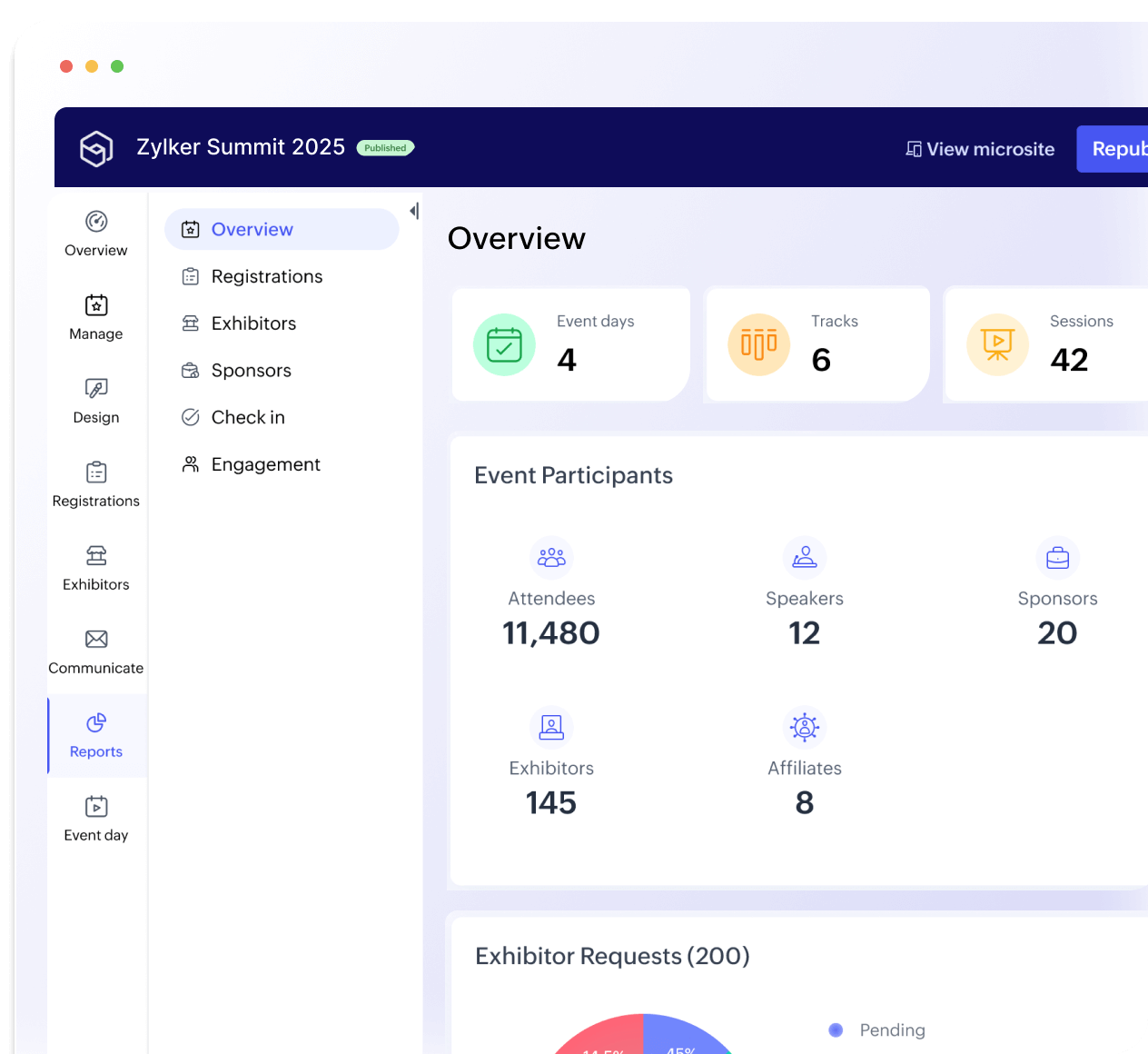
For example, in Zoho Backstage, you can manage search visibility, optimize metadata, add keywords for local SEO, and set categories, tags, and alt text—all without touching code. The platform handles mobile responsiveness, page speed, and schema markup for you, so you can focus on content and strategy instead of troubleshooting technical issues.
3. Implement event schema markup
Schema markup is structured data that tells search engines exactly what your event is—not just that a page mentions an event, but the precise details: name, date, time, venue, ticket price, and organizer. Without a schema, search engines have to infer context. With it, they instantly understand your event. Your event schema markup includes:
Event name and description
Start and end date/time
Venue name and full address
Organizer information
Ticket availability and pricing
Event type/category
Image for display in results
Why this matters: Schema unlocks rich results in Google, where event details appear directly in the search listing. Instead of a plain blue link, users see the date, location, and a ticket link—making your event far more prominent and clickable than a standard result.
If you set up the schema correctly, your event can appear in Google's Event Pack, which shows up above regular search results. It usually increases click-through rates because people see key information right away and can go straight to your ticket page.
Most event management platforms, such as Eventbrite, Zoho Backstage, and others, automatically create a schema from the details you provide. If you build a custom event page, you'll need to add the JSON-LD schema yourself. You can use Google's Structured Data Markup Helper or other tools to generate the code. After adding it, check your setup with Google's Rich Results Test.
4. Build a content ecosystem with strategic internal linking
Your event landing page shouldn't stand on its own. Build a connected content ecosystem that reinforces authority, helps people navigate, and ultimately guides them toward registration. Here's how to do it:
Link past events to upcoming ones: Keep previous event pages live to preserve backlinks and rankings. Add a banner or CTA pointing to the forthcoming event and funnel that existing authority to your current page.
Create topic clusters around your event themes. If you're hosting a sustainability conference, publish content on related topics such as renewable energy trends, corporate ESG strategies, and climate policy updates. Each piece should link to your main event page and to the other, creating a web of relevance.
Capture related search queries and publish informational posts, such as "What to Expect at a Tech Summit," to reach early-stage searchers. Use internal links to guide readers toward your agenda, speakers, and registration page.
Guide users through your content: Use internal links to connect recaps, speaker bios, and supporting pages to your main event page. Ensure that every page provides users with a clear next step toward registering.
💡This approach also works when you're hosting side events alongside larger conferences. Stitchflow, for example, organized a networking dinner during Okta's Oktane 2025 and used Okta's brand visibility to drive discovery. As a newer brand, they published supporting content around Oktane—such as a "top tips" guide for making the most of the conference—to capture related searches and funnel interest toward their own event.
Finally, repurpose post-event content for ongoing SEO value. Publish recap blogs highlighting key takeaways, upload speaker session videos, share photo galleries, and conduct post-event interviews with speakers or attendees. This content serves multiple purposes:
It provides social proof for skeptical prospects,
It keeps your event visible in search results during off-season months
It attracts next year's attendees who are researching what to expect
Video is compelling—session recordings, highlight reels, and behind-the-scenes footage give prospects a tangible sense of what they'll experience. For example, you'll find all our Zoholics highlights (Zoho's flagship event series) on YouTube.
5. Leverage local SEO for physical and hybrid events
Local SEO optimizes your event to appear in location-specific searches—when people look for events happening in their city or region. If your event has a physical location, this is how you reach the right geographic audience.
Here's how to optimize for local SEO:
Use local keywords: Draft content for location-specific terms like "marketing conference in Chicago" or "Chicago marketing events 2026"—include neighborhood names, landmarks, and venue names to reinforce geographic relevance.
Get listed in local event directories and calendars: Submit to city-specific event sites, tourism boards, local news outlets, and chamber of commerce calendars. These listings provide backlinks and reach local audiences actively searching for things to do.
For multi-city event series, create location-specific pages: Build separate landing pages for each city with unique content—local speakers, city-specific agendas, venue details, nearby hotels, and transportation options—to rank for multiple location-based searches.
The more localized signals you build (keywords, directories, backlinks), the more visible you become to the right audience at the right time.
6. Build authority through strategic backlinks
Backlinks—links from other websites to your event page—are one of the strongest signals of credibility to search engines. When reputable sites link to you, it tells Google and AI platforms that your event is worth paying attention to. The challenge is earning those links naturally.
One way is to partner with sponsors, speakers, and venues for natural backlinks: These are the easiest wins:
Your speakers should list your event on their personal websites or LinkedIn profiles.
Sponsors should feature your event on their "Events We're Supporting" pages.
Venues typically have event calendars—make sure yours is listed with a link.
These are mutually beneficial relationships, so don't hesitate to ask. Provide them with pre-written copy, graphics, and direct links to make it easy.
Another idea is to reach out to industry blogs, trade publications, and news sites that cover your event's topic. Offer to write a guest post on a relevant subject—"5 Trends Shaping [Your Industry] in 2026"—and include a mention of your event in your author bio or within the content where appropriate.
Pro tip: Engage in Community Forums for GEO
Don't forget about platforms like Reddit, Quora, and industry forums. They are beneficial for Generative Engine Optimization (GEO). These sites are often indexed and used by AI tools to generate answers, so being active there can help your event get mentioned in ChatGPT or Perplexity results.
If you're organizing a marketing conference, engage authentically in subreddits like r/b2bmarketing or r/genzmarketers by contributing to discussions. When appropriate (and in accordance with community rules), mention your event as a resource.
7. Measure performance and refine strategy
SEO without measurement is guesswork. You need to know what's working, what's not, and where to focus your efforts. Tracking the proper metrics turns SEO from a hopeful exercise into a data-driven strategy. Some key metrics to monitor are:
Organic traffic: How many people are finding your event page through search engines? Track this over time to see if your SEO efforts are increasing visibility. Look at traffic sources in Google Analytics—organic search should be growing as your optimization improves.
Keyword rankings: Are you ranking for your target keywords? Use rank tracking tools to monitor where your event page appears for terms like "marketing conference Austin 2026" or "tech events spring 2026." Ranking improvements indicate your SEO is working; drops signal you need to adjust.
Conversion rates: Traffic means nothing if people don't register. Track how many visitors from organic search actually buy tickets or sign up for updates. If rankings and traffic are up but conversions are flat, your landing page needs work—not your SEO.
Google Analytics is sufficient for this. It's free, and it shows traffic sources, user behavior, and conversion paths. Set up goals to track ticket purchases or registration form submissions.
And Zoho Backstage integrates with it (and advanced web analytics tools like Zoho PageSense) out of the box. So when you create your event website with Zoho Backstage, you have this from day 1.
Choose event software that supports your SEO strategy
SEO isn't a one-time checklist. The work you put into keyword research, content creation, and backlink building compounds over time, creating visibility that extends across multiple event cycles. And if your event management platform (or event website builder) makes basic optimization difficult, you're fighting an uphill battle before you even start.
Zoho Backstage has SEO built in. Your pages are automatically mobile-optimized and fast-loading, and you still get complete control over categories, tags, summaries, and search visibility. With the technical foundation handled for you, you can focus on strategy: creating content, building backlinks, and optimizing for the keywords that matter.
Optimizing for Google Search focuses on ranking in traditional search results through keywords, backlinks, and technical SEO. Optimizing for AI engines like ChatGPT (GEO) focuses on being cited when AI tools generate responses. The good news: strong traditional SEO practices feed directly into AI visibility.
Start with Google's autocomplete and "People Also Ask" sections—type your event topic and see what questions appear. Use free tools like Google Keyword Planner to check search volume for terms related to your niche.
You can also look at competitor event pages to see what keywords they target, and focus on long-tail, specific phrases like "[niche topic] conference for [specific audience] in [location] [year]" rather than broad generic terms.
Yes, keep old event pages live—they hold SEO value through existing backlinks and historical rankings. Update them with a clear banner linking to your upcoming event and add post-event content such as recaps, videos, or testimonials.
This redirects their authority to your current event while providing social proof for prospective attendees researching what to expect.
SEO results for events typically take 2-4 months to gain traction, though you might see early movement in 3-6 weeks for low-competition keywords. Start your SEO work at least 3-4 months before your event date to capture people in the research phase.
For recurring events, the timeline shortens significantly. The previous years' SEO work compounds, meaning your second or third event will rank faster than your first.