How to increase registrations with smart event referral marketing
See why word-of-mouth marketing outperforms other channels and how to build an event referral program with clear rewards, automated tracking, and a system your attendees will actually use.
Paid search keeps getting more expensive every quarter, yet somehow delivers less. Email open rates keep slipping because everyone's inbox feels like a battleground. And SEO? It's in existential limbo—everyone's still figuring out how AI will reshape organic search patterns before the next updates hit.
Meanwhile, referral marketing, the oldest marketing channel, still outperforms everything else. According to McKinsey, people in Europe and the United States report that family and friends influence them the most when it comes to brand or product recommendations.
This is why event referral marketing works: it's trust-based, cost-effective, and taps into networks your audience already maintains. You're not interrupting strangers with cold-calling or spray-and-pray emails. Instead, you're activating advocates.
Effective referral marketing strategies for event promotions
What is event referral marketing?
Event referral marketing is a strategy where you encourage attendees, sponsors, exhibitors, and speakers to promote the event to people they know in exchange for an incentive. This can be a discount, VIP access, cash reward, or free ticket. It works because personal recommendations still outperform every ad platform you can buy.
TwitchCon is a great example. After you buy a ticket, you get a unique referral link tied to a tiered set of rewards:
3 referrals = 25% off
5 referrals = 50% off
10 referrals = a free ticket
Attendees can track everything in their account dashboard, and TwitchCon emails them each time someone signs up through their unique link.
But referrals aren't only for promoting your event to attendees. You can use the same mechanics to recruit exhibitors and sponsors. For example, if an existing sponsor refers to another sponsor, both could get upgraded to the next sponsorship tier. If an exhibitor brings in a peer exhibitor, they could earn booth credits or premium placement.
Why referral marketing is perfect for events
Events demand exceptional commitment from all stakeholders, especially from the attendees. Unlike clicking "buy" on a $30 product, attending an event means blocking time on the calendar, arranging travel, spending hundreds of dollars, and finally, showing up in person (or virtually).
That's a high-friction decision that can change at any minute up until the event starts. And that's why referral marketing is uniquely effective for events:
The trust factor is amplified: When people are deciding whether to commit time and money to an event, they lean on recommendations from people they know. An ad just can't compete with that.
Events have built-in advocacy moments: When attendees have a good experience, they naturally want to tell others. A referral program just gives that impulse a place to go.
Multiple stakeholder tiers multiply reach: Attendees, sponsors, exhibitors, and speakers all have different networks and varied reasons to spread the word. This expands your reach in ways most channels can't.
So with the right referral strategy, you can turn every satisfied attendee into a scalable acquisition channel that costs less and converts better.
6 best practices for planning your event's referral program
Now let's get specific about how to build a referral program that turns your attendees into your most effective marketing channel.
Match your referral program scope to your bandwidth
On paper, referral programs look deceptively simple: hand out links, track clicks, issue rewards. In practice, it gets complicated almost immediately. You need:
Unique tracking URLs for every advocate
Automated reward fulfillment
Integration with your registration system
email triggers and fraud alerts
Dashboards for ROI tracking
Multiply that by a few hundred—or a few thousand—attendees, and you're no longer running a simple campaign. That's why you should match the scale of your referral program to the resources you can realistically sustain; otherwise, it could backfire, leading to service issues on all sides.
Minimal scope : Sponsors and speakers only
Best for: Teams of 1–3, first-time programs, events under 500 attendees.
If you're just getting started, we suggest keeping a low-key referral program and working with sponsors and speakers. They already care about the event, and usually have solid networks.
You can give them referral links and track things however you can, even if it's a simple spreadsheet. This is pretty easy to do, and you don't need specialized tools or a large team.
Medium: Add exhibitors, partners, or a curated set of influencers
Best for: Teams of 3–5, B2B conferences, trade shows, niche-community events.
If you've got a bit more bandwidth in terms of resources like budget and manpower, you can open it up a little. Loop in exhibitors, partners, maybe a couple of niche influencers. They'll extend your reach without creating a pile of extra work. And if you're running a B2C event, influencers can be especially helpful. In fact, according to SocialToaster, 76% of people are more likely to trust content from "normal" people than brand messaging.
At this stage, you can rely on lightweight affiliate tools built into event management platforms—like Zoho Backstage—to handle link creation and conversion tracking.
Full: Open it to all attendees
Best for: Event teams of 5+, recurring events with loyal audiences, festivals or concerts with 1,000+ capacity.
If you've got the team and the tools, you can just open the referral program to everyone. At that scale, you can't run it by hand anymore, and you'll need something like ReferralCandy or Viral Loops to handle all the tracking and reward triggers.
It's definitely a more involved setup, but the reach you get is on a different level. Once the whole attendee base can refer, the program can really benefit you.
Identify your best advocates
Once you've set the scope of your referral program, the real question is who you can rely on to actually move people. The categories—attendees, exhibitors, sponsors—matter much less than the underlying traits that make someone a strong advocate. Three qualities tend to dominate: credibility, reach, and enthusiasm.
Credibility
People listen to advocates who have firsthand experience and can speak persuasively about your event's value. In fact, according to McKinsey, 82% of GenZ trust friends and family when it comes to purchases.
Attendees: Past participants with high engagement—session attendance, active app usage, thoughtful survey responses.
Exhibitors: Companies that have achieved measurable ROI at previous events and can speak plainly about results.
Sponsors: Long-term partners who understand your event's audience and have a track record of alignment with your mission.
Reach
Some advocates don't just influence individuals; they impact communities. In fact, according to SproutSocial's 2025 Influencer Marketing Report, 49% of respondents make purchases at least once a month because of influencer content.
Attendees: Influencers, speakers, and thought leaders whose recommendations travel far beyond their immediate circles.
Exhibitors: Well-known brands with strong industry visibility and networks that follow their lead.
Sponsors: Organizations active on the conference circuit or in industry publications, with followings across large professional communities.
Enthusiasm
All-in people have a natural ability to convince others as people often respond to advocates who genuinely care.
Attendees: First-timers who express excitement through social posts, early registrations, or unprompted feedback.
Exhibitors: New companies eager to maximize their investment and make the most of their presence—even with smaller networks.
Sponsors: Premium-tier partners who have already invested heavily in visibility and want to drive strong attendance.
Peer influence bias and referral marketing
Peer influence bias is the tendency where people base their decisions on what those around them are doing (friends, colleagues, or anyone they trust) rather than their own independent interests. Event referral marketing works because it activates this exact bias. When someone hears about an event from an "enthusiastic" friend or brand—especially someone whose opinion they trust—they're more likely to register.
Design incentive structures that actually motivate
Incentives are where many referral programs fall flat. Cash is the obvious choice, but it's rarely the most cost-effective one. Non-cash rewards consistently outperform cash payouts—by 24%, according to ReferralCandy—because money feels transactional and hints at you as desperate.
A good referral program builds on that idea. Instead of a one-and-done reward—"refer someone, get $20"—use tiers that create momentum:
One referral gets you a discount on next year's ticket
Three unlock the VIP lounge
Five get you a free ticket and maybe a backstage pass
At ten, you're at the speaker dinner
Basically, you're gamifying the experience. That works when every attendee is involved and engaged. But if your referral effort is limited to a smaller group, the incentives need to look different.
With speakers or VIPs, status matters more than a discount ever will. Give them priority access backstage, a quick meet-and-greet with your keynote, or early access to content. They already care about the event, so you're just giving them something that fits how they participate.
Sponsors and exhibitors, on the other hand, are looking for business impact. They want better booth placement, stronger branding, a mention in a pre-event email, or a break on next year's renewal. Those perks tie directly to why they're there.
So the rule is simple: match the reward to what the group actually values. Big, open programs run on momentum. Smaller, focused ones run on relevance.
Make referring effortless, and rewards instant
People already share events they're excited about. Your process has to make that impulse effortless. The harder you make the process, the faster referrals drop off.
The first step is removing every possible point of friction. Give each advocate a unique link or code the moment they join your program. They shouldn't have to ask for it, dig for it, or track anything manually. When someone registers through that link, the system should recognize it instantly.
Then make sharing a one-click action. Don't force people to write their own messages. Give them short templates they can send as-is or tweak if they want:
"I'm attending [Event Name] and thought you'd find it valuable. Here's 20% off your ticket: [link]."
Clarity also matters. Event advocates should understand what they get for referring, what their friend gets, how to share, and when they'll receive the reward. You can even create a separate Terms and Conditions page for your referral program, like Route Consultant Expo.
That's on the advocate side of things. Here are some pointers for how you can keep things clean on your side so you know when someone's eligible for a reward:
Track all referrals through a single dashboard, not scattered spreadsheets.
Use automated attribution, so every referral is tied to a specific link or code without manual checking.
Set clear rules for reward eligibility, like refund windows, duplicate referrals, fraudulent registrations.
Trigger automatic notifications (to you and the advocate) the moment a referral converts.
Log reward fulfillment in the same system, so there's no guessing about who received what.
Run periodic audits to ensure the tracking and payout system isn't being gamed.
This keeps the referral program fair and scalable, so your team isn't drowning in manual checks while referrals roll in.
Promote your referral program
A referral program only works if people actually know it exists. Too many teams build a solid system and then hide it in a footer or a passing sentence in an email. If you want referrals, advertise it everywhere your audience already shows up. And repeat it often, assuming people need multiple reminders before they act.
Here are some ways to promote your referral program:
Purchase confirmation page: This is your single highest-converting window. They're excited, they're paying attention, and they just said yes to your event.
Ticket confirmation email: Include the referral CTA in the confirmation email. Something as simple as: "Share [Event Name] with your network and get 25% off next year's ticket for every 3 referrals." is enough to get the word out.
Drip campaigns: Build a short sequence that keeps the program visible without feeling repetitive—like an intro email explaining the rewards, a mid-cycle reminder featuring top referrers, and a final nudge as the event approaches.
Social posts: Create posts that show the reward tiers visually and spell out exactly what someone gets for sharing. You can also pin the referral program to your profile or add it to your bio link so it's impossible to miss.
Apart from these, empower your speakers and sponsors with pre-written posts, email copy, and their own referral links so all they have to do is hit "publish." When you make it effortless, they actually do it.
Track, measure, and optimize
Like all your event marketing channels, your referral program also needs to be constantly monitored. The good news is that referral programs are inherently measurable. Attribution is literally built in: you can see exactly who's sharing, who's converting, and what it's worth to your event.
Here are some event metrics to track to check the ROI of your referral marketing efforts:
Referral conversion rate: How many referred visitors actually register. This tells you whether your offer and landing experience are compelling.
Share rate: The percentage of attendees who share their referral link at least once. If this number is low, the issue isn't your incentives—it's awareness or friction.
Revenue per referral source: This tracks which advocates generate the most value and helps you identify your strongest promoters and prioritize where to invest time or perks.
Referral velocity: The time between when a link is shared and when someone converts. Faster velocity usually signals clear messaging and low friction; slower velocity reveals drop-off points.
Average value of referred vs. non-referred attendees: Referred attendees often spend more and return more. This metric shows whether referrals are bringing in higher-quality registrants, not just more of them.
Get these metrics right, and you'll know exactly where to push, refine, or double down.
Run your event referral program—and everything else for your event—with Zoho Backstage
Referral marketing slots naturally into an event strategy because it mirrors how people already make decisions: through trust and real networks. But for referrals to work at scale, you need a platform that removes the friction.
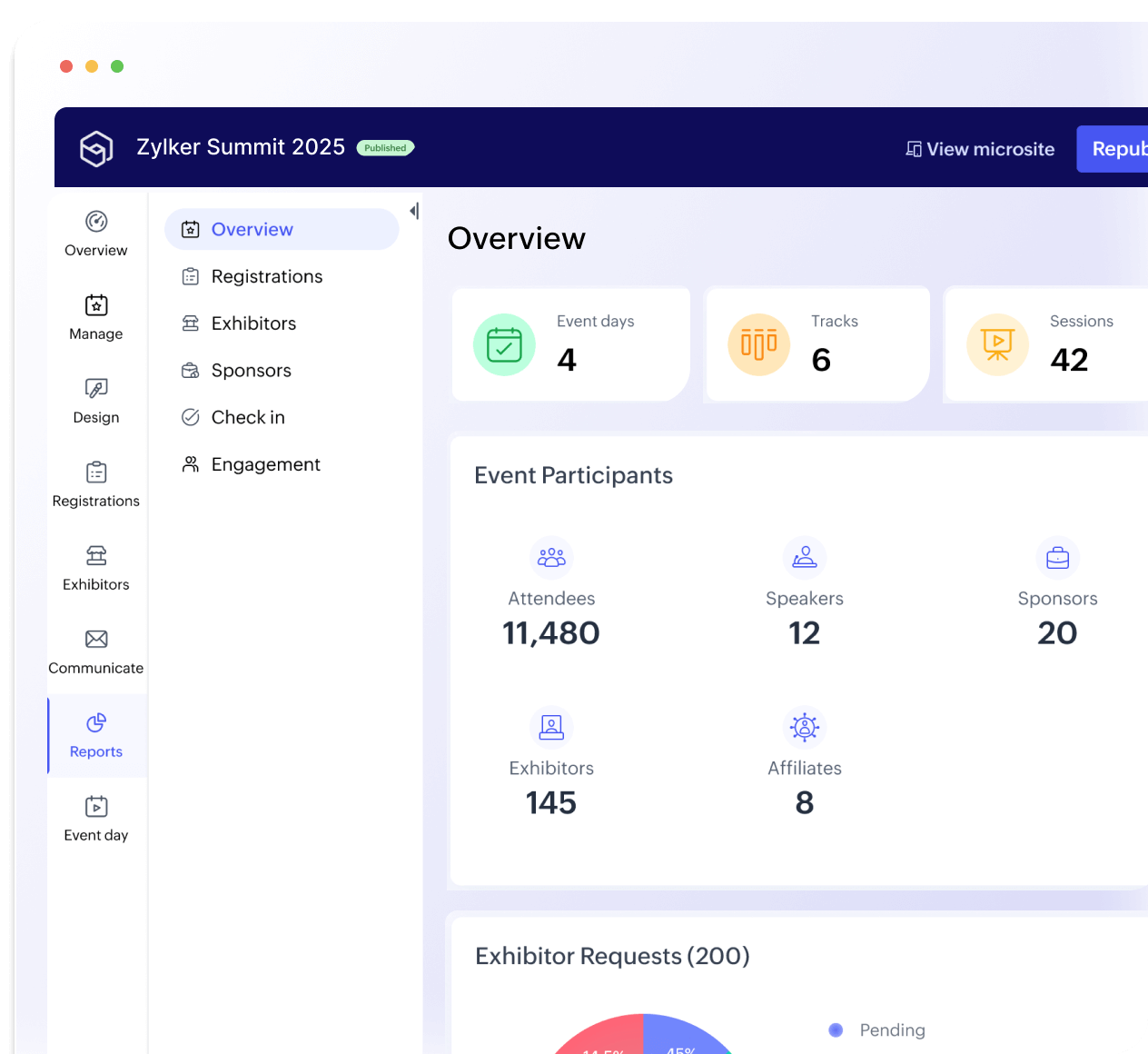
Zoho Backstage does just that. It gives you built-in affiliate marketing tools with automatic tracking and clear dashboards. You can see who's sharing, who's converting, and what's driving the most registrations.
And because Backstage handles registration, email campaigns, speaker management, and analytics in one place, referrals don't become another system to manage. It's part of your existing workflow.
The simplest way to keep fraud out is to rely on unique referral links, verify every registration before issuing rewards, and block self-referrals or duplicate email attempts. Most referral platforms will catch suspicious patterns before they become a problem.
You don't need much to start an event referral program. A small, focused program can run with one person and basic tools. Once you open it to all attendees, you'll want proper software and a small team to handle tracking and fulfillment.
Referral marketing actually thrives in virtual and hybrid settings. Sharing is easier, attendance requires less commitment, and digital audiences tend to pass links around faster. The same incentives work; you just see shorter cycles from share to registration.
Launch your referral campaign the moment your first tickets go on sale. Early buyers are your most enthusiastic advocates, and giving them 6–10 weeks to share creates a steady pipeline of warm leads. Waiting until the final stretch leaves most of that momentum on the table.