At the outset, each of these event management software has all the basics you need to run your events, such as ticketing, workflow management, analytics, and more.
However, a closer look reveals a host of nuances in features, capabilities, and pricing that can give you a unique event-planning experience. Different event planning platforms are suited for different event strategies and teams—a B2B business running 50 webinars a year needs a completely different choice than a B2C organization running yearly tradeshows worldwide. This is because both need separate types of integrations with tools, scale of attendees and pricing factors to suit their requirements.
Let's explore each of the event management software in detail to understand what fits best for each team size, event goals and budgets.
1. Zoho Backstage
This all-in-one event platform is built for teams that want complete control over the entire event lifecycle within a single connected system. Unlike many other platforms, it's not a customer engagement software turned events app, or a purely AI-native digital management software that also handles events.
Instead, think of it as a software built for event teams, by event teams—on the recursive feedback and pain points that real-life organizers face while scaling events.
From planning and registration to event promotions, engagement, and post-event reporting, every single critical capability is integrated seamlessly within a single control center on the platform.
The software was created for agile teams who are constantly building and scaling their events strategy: it supports all major event types (in-person, virtual, and hybrid) across scales, and is equally powerful in organizing a 3-person event team running virtual-only events or a 1000-attendee hybrid conference.
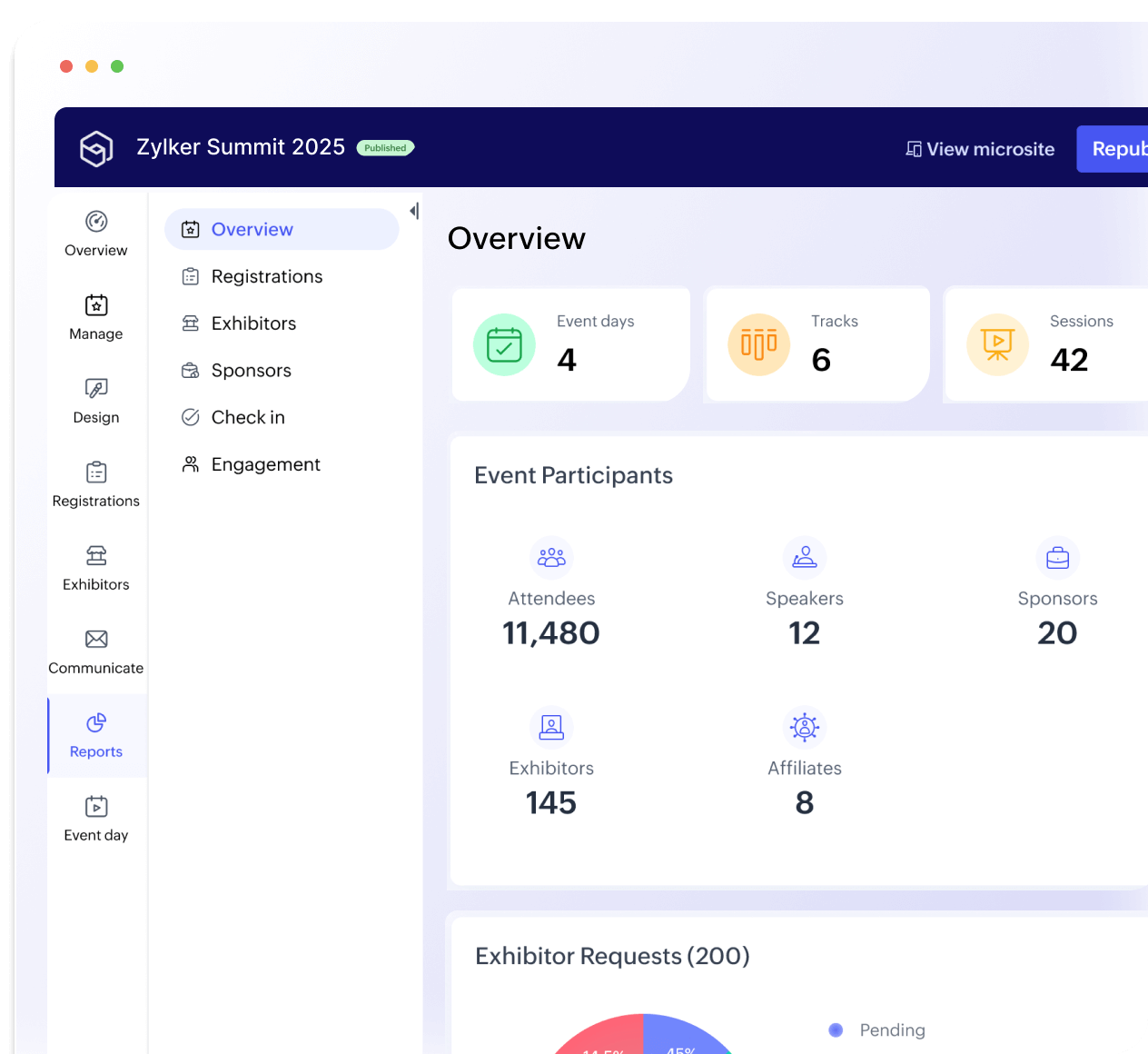
Backstage's strength lies in its modularity. As an all-in-one event planning platform, it offers a suite of powerful digital tools across the event lifecycle—ticketing, check-in and badging, streaming software, attendee engagement, website builders, mobile apps and more—so businesses need not spend budget or resources on any external app, agency or staff.
It has one of the most sophisticated attendee management modules that modern platforms have to offer: from multi-class ticketing and promo codes, built-in communication scheduling to contactless, customized badging and entry in fully automated workflows that save hours everyday for teams.
Additionally, it is 100% dependable when it comes to security (SOC 2, GDPR compliance) and reliability, while having a simplified and functional interface that helps event teams streamline tasking and improve event ROI.
The platform is also intuitive enough to help ensure any user across the business front can build and scale events instantly as demonstrated by Fluetic International, which built an entire two-day event (complete with a full-fledged website, ticketing, agenda, etc.) in just an hour and a half with Backstage.
Pros:
- Generous free plan that offers unlimited events, major modules, various integrations etc
- All-in-one lifecycle coverage for both SMBs and enterprises
- Powerful check-in and ticketing module with easy customization
- Native integrations, enterprise-grade security
Limitations: It is not entirely AI-first focused yet. But in time, with various integrations, it will be there.
Verdict: Use Zoho Backstage if you want a flexible, feature-rich product that grows with your event strategy.
2.Bizzabo
Bizzabo is an important player in the event planning space for large teams and mid-market teams. It is the "Event Experience OS" and heavily centered on providing advanced technology capabilities at every step of the way.
Bizzabo, too, brings in all key event management features like registrations, attendee engagement, mobile app builders and more under one roof across in-person, hybrid and virtual events. As an enterprise-class software, the platform is able to run smoothly across thousands of attendees and concurrent sessions, thanks to its firm backend infrastructure.
One of their champion offerings is the Klik smart event badges— wearable devices that track attendee movement and interactions across sessions and booths.
Owing to this feature, the analytics suite offered by Bizzabo is highly amplified, and can segment and export engagement metrics by session, sponsor, or attendee group —these are capabilities that smaller platforms and most free tools often lack.
This focus on intelligence makes Bizzabo a strong choice for teams that measure sponsor performance and attendee ROI post the event. However, most of these features are only needed for larger businesses that run multi-track, high-volume conferences.
The pricing starts at $499 per user per month (three-user minimum), which puts it firmly out of reach for most SMBs or growing teams to test out or start with. Additionally, Bizzabo's heavy technology focus still has some limitations on configurations and customization, especially within the marketing and promotions modules as per reviews.
Pros:
- Industry-leading analytics and attendee insights.
- Advanced onsite tech (Klik badges, wearables).
- Scales easily for high-volume, multi-track conferences.
Cons: Some G2 reviews highlight the lack of customizations, and the marketing and promotions module (landing page builder, emails etc.,)
Verdict: Use Bizzabo if you are a large team with an established event strategy looking for extensive smart tech tools and AI capabilities for execution (minus marketing, promotions, etc., that you can do elsewhere)
3. vFairs
vFairs has carved out a clear niche as the go-to platform for virtual events, especially large-scale virtual events that have a focus on networking and attendee collaborations.
One of the unique modules of vFairs—the 3D virtual lobby—makes it a great choice for teams that run events like job fairs, virtual conferences, career expos etc.
vFairs is able to handle registration, ticketing, mobile apps, badge management, exhibitor lead capture, and analytics under one roof, which makes it suitable for both SMBs and larger teams. Additionally, the vFairs team also offers the flexibility of customizing the platform as per business needs, complete with a mobile app for organizers.
Pros:
- Excellent for large-scale virtual or hybrid expos.
- Detailed 3D branding and high engagement tools.
- Reliable performance and enterprise-level compliance.
- Dedicated event support and customization options.
Limitations: Some reviews suggest complex backend, steep learning curves and other limitations, besides no open pricing quote. For most businesses running simplified virtual/hybrid events, most of the features might be an overkill to pay for.
Verdict: Pick vFairs if your events revolve around exhibitors, sponsors, or immersive digital experiences. It's not lightweight, but it delivers when engagement depth and audience scale are non-negotiable.
4. Cvent
Cvent, a popular event planning software, is used by both mid-market and large enterprises for all types of events, often accommodating 1000s of attendees over multiple tracks simultaneously. It offers dedicated modules for event management, field marketing, attendee engagement and more—besides a platform specifically for venue managers as well.
Essentially, it is engineered for organisations that run large-scale conferences, roadshows, and multi-location events where logistics and vendor coordination are as complex as attendee management.
Cvent's platform contains two layers: the event-planning engine (registration, agenda, check-in) and a powerful marketplace of venues and suppliers. Its modules for venue sourcing and event diagramming make it an operational tool as much as they support event managers.
The trade-off for this enterprise depth is cost and complexity. Pricing, however, is quote-based, typically combining annual licenses with per-registrant fees, which is practical for large teams but not so much for budget-conscious ones.
Pros:
- Deep enterprise modules for venue and supplier management.
- Highly reliable infrastructure and strong compliance record.
- Wide partner ecosystem and 24/7 enterprise support.
Limitations: Pricing can be a huge determiner, ruling out even mid-market teams. Some G2 reviews do mention a steep learning curve, and the interface feels a little outdated—so a bit of training might be required.
Verdict: Cvent is for enterprises looking for a dedicated, all-encompassing solution with numerous modules.
5. RingCentral Events
RingCentral Events, formerly Hopin, is now owned by RingCentral, a company recognized for its expertise in cloud AI capabilities for voice and customer engagement. RingCentral Events thus brings that same strength into the event space.
The platform supports all major event formats—virtual, hybrid, and in-person—and its core differentiator lies in how it uses AI and communication technology to enhance virtual and hybrid experiences. Its event product integrates streaming, chat, breakout sessions, and AI-powered engagement tools.
Like vFairs, RingCentral also uses technology to enhance virtual experiences to the maximum, and is often used by event teams who organize running recurring webinars, hybrid launches, and digital summits that demand consistency without complexity.
Pros:
- Predictable pricing and unlimited registration options.
- Reliable streaming and communication backbone.
- Built-in AI tools for engagement and content repurposing.
- Quick setup for digital events.
Limitations: Some reviewers mention that there are issues with streaming, and the software is not as comprehensive enough for in-person events as it could be.
Verdict: RingCentral Events is ideal for digital-first teams that prioritise engagement and content automation.