Your debrief template should answer the questions that reveal why your event performed the way it did and what needs to change. These nine questions cover goal achievement, audience behavior, budget reality, and execution.
1. Did we meet our primary event goals and KPIs?
Start by comparing the goals you set in the event brief to the actual results for registrations, marketing activities, attendance, revenue, leads generated, and engagement metrics. Then identify where you exceeded targets and where you missed them.
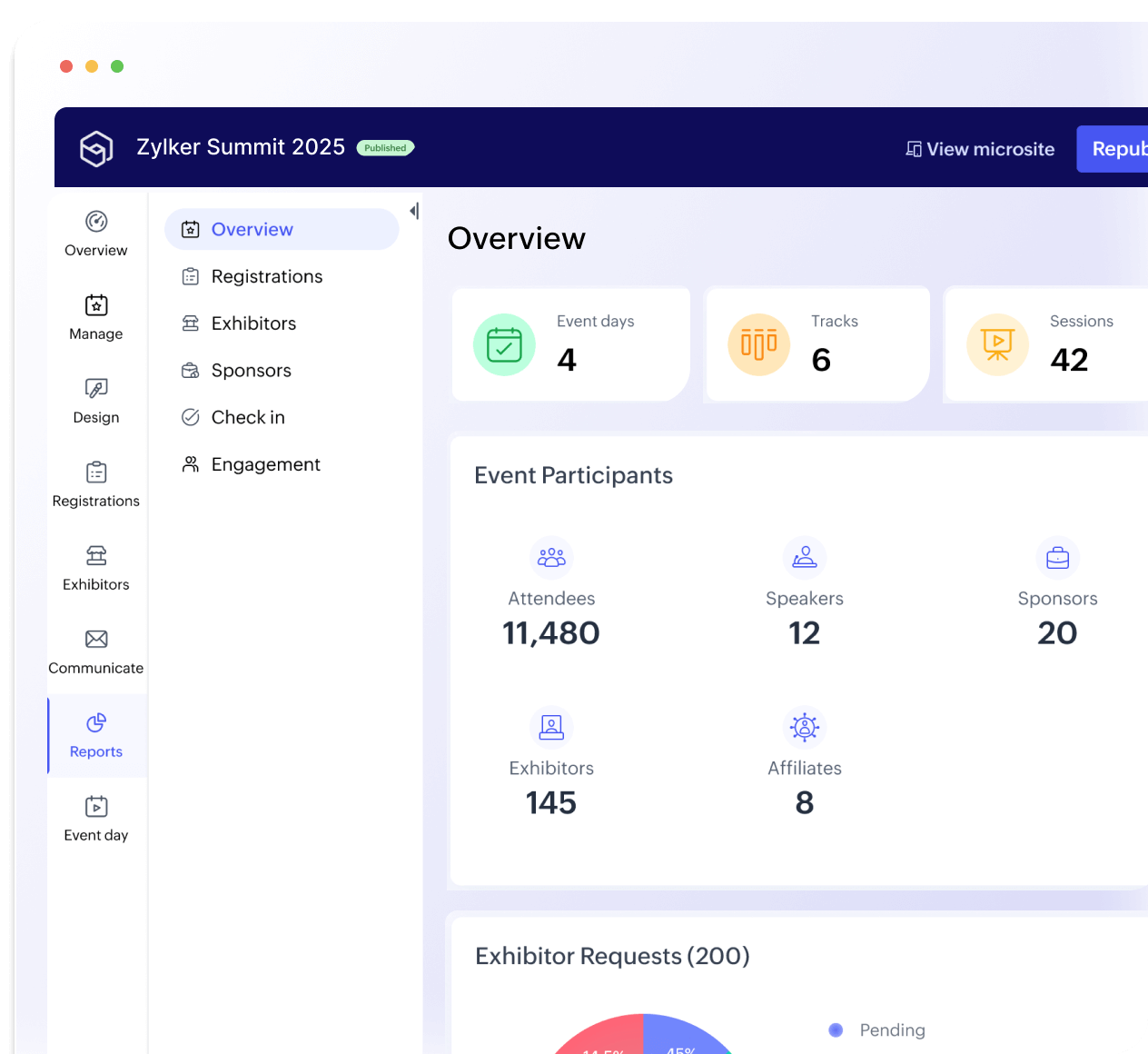
If you're using an event platform like Zoho Backstage, you can conveniently pull this data before you start the debriefing. Its real-time dashboards track registrations, attendance, engagement, and session performance. Export the reports to CSV or PDF, so your team has the whole picture in one place when you walk into the debrief.
Don't stop at the numbers, document why each variance happened:
- Did a last-minute speaker boost registrations?
- Did a competing event pull your audience?
- Did poor email timing hurt ticket sales?
These explanations reveal patterns you can replicate or avoid next time. But before you start planning improvements, take a step back and assess whether your original goals were realistic.
If you aimed for 500 registrations but your email list had only 800 contacts and a 10% conversion rate, your goal was mathematically impossible from the start. Unrealistic targets don't just set you up for failure—they waste budget and demoralize your team.
2. What did our engagement metrics reveal about attendee behavior?
Now that you know whether you hit your top-line goals, dig deeper into how attendees actually experienced your event. Pull session attendance data and identify drop-off patterns. Review in-session engagement—poll responses, Q&A participation, chat activity—to see which topics and formats held attention.
Here again, your event planning software can help. Most platforms—including Zoho Backstage—track engagement automatically with features such as session analytics, booth scan reports, and attendee surveys, so you don't have to do it manually.
Finally, look at where attendees actually spent time: booth scans, networking appointments, app logins, and content downloads. For example:
- High booth traffic but low lead quality can mean your floor plan worked, but your exhibitor targeting didn't.
- Low event app adoption can mean attendees didn't see the value in downloading or the event app's UX got in their way.
- High registration for breakout sessions but low actual attendance can mean you scheduled too many competing sessions or placed popular speakers in conflicting time slots.
These patterns tell you what to replicate, what to fix, and where your planning assumptions didn't match attendee behavior.
3. How did our marketing tactics perform across channels?
Your engagement data shows what happened at the event—now look at what got people there in the first place. Pull attribution data to see which channels drove the most registrations: email marketing, social media, paid ads, partner promotions, or organic search. Don't just count total registrations per channel—calculate cost per registration to understand efficiency.
A channel that generated 100 registrations at $50 each is less valuable than one that generated 80 registrations at $15 each.
Finally, look at which messaging and creative assets resonated. If your "learn from industry leaders" angle outperformed "network with peers," that tells you what your audience values. If video ads convert better than static images, adjust your creative budget accordingly.
Pro tip: Measure marketing's contribution to pipeline, not just registrations
Most event marketers stop at registration metrics. That tells you which channels filled seats, but not which channels brought buyers. To measure true marketing ROI, track which channels generated leads that converted:
- Attribution by channel: Connect registrations to lead source (email, paid social, partner referral) and track those leads through to closed deals.
- Channel efficiency: Calculate cost per MQL and cost per opportunity by channel—not just cost per registration.
- Quality over volume: Identify which channels brought attendees who engaged most and converted fastest.
Event management platforms with CRM integrations (Zoho CRM, HubSpot, Marketo) connect registration source data to opportunity records. This turns your marketing debrief from "email drove 200 registrations" into "email-sourced attendees generated $500K in pipeline at 15% lower cost per opportunity than paid ads." Something your leadership team would love to know!
4. Were there surprises in our attendee demographics?
Marketing channels tell you how people found your event—demographics tell you who actually showed up. Compare your actual attendee breakdown to the target audience profile you built during planning. Look at industries, company sizes, job titles, seniority levels, and geographic locations.
If you planned a SaaS conference expecting IT directors but half your attendees were marketing managers, it changes your content strategy, sponsor targeting, and session formats for next time.
Next, compare this event's demographics to your previous one to spot longer-term trends. If enterprise companies are replacing SMBs in your audience, your pricing, sponsorship packages, and content depth should evolve with them. If international attendance is growing, consider time zone-friendly sessions or multilingual support.
Finally, flag accessibility needs or accommodations that came up unexpectedly. If multiple attendees requested ASL interpretation, quiet rooms, or dietary accommodations you didn't plan for, build those into your next event budget from the start instead of scrambling to arrange them last-minute.
Pro tip: Use your registration data to spot patterns you'd miss manually.
Export attendee demographics from your event platform (industry, company size, job title, location) and upload the CSV to an AI tool like Claude or ChatGPT. Ask it to identify unexpected clusters, compare segments to your target profile, or flag demographic shifts from your last event. This takes 2 minutes and surfaces insights that would take an hour to find in spreadsheets.
5. Did we stay within budget, and where did variances occur?
Pull your final budget and compare planned spend to actual spend across every line item. Flag anything that varied by more than 10%, whether over or under. Then identify costs that weren't in your original budget. These unplanned expenses reveal gaps in your planning process or unrealistic vendor agreements. This is also a good time to note where you could have negotiated better rates or chosen different vendors.
Finally, assess whether your initial budget was realistic. If you allocated $5,000 for speakers but needed $12,000 to attract the caliber your audience expected, your budget didn't match your goals. Unrealistic budgets force you into reactive decisions that cost more and deliver less.
6. How well did our event format (in-person, virtual, hybrid) serve our goals?
Start by assessing whether your chosen format delivered what you intended. If you went hybrid to expand reach, but 90% of engagement came from in-person attendees, your virtual experience failed. If you chose in-person for networking but attendees spent most of their time in sessions, your format didn't enable the behavior you wanted.
This is also where you identify format-specific challenges and separate what you can fix from what's built into the format itself:
- Virtual events: Screen fatigue, home distractions, and lack of spontaneous networking (format limitation) vs. poorly moderated Q&A or clunky platform navigation (execution failure)
- Hybrid events: Audio imbalance that makes remote attendees feel ignored (execution failure) vs. inability to recreate the energy of an in-person room for virtual attendees (format limitation)
- In-person events: Long registration lines or confusing signage (execution failure) vs. travel costs that prevent some of your target audience from attending (format limitation)
Knowing the difference matters because execution failures can be prevented through better planning, vendor selection, or technology.
Finally, consider whether a different format would have delivered better results for the same budget. Could you have reached the same audience with a virtual event at one-third the cost? Would in-person have driven a stronger sponsor ROI even with higher expenses? This isn't about regretting your choice, but about doing better next time.
7. What did speakers, sponsors, and vendors think of the event?
Your attendees evaluate your event, but so do the partners who made it happen—and their satisfaction directly affects whether you can rerun this event. Speakers who had a poor experience won't return, and they'll tell other potential speakers in their network.
Sponsors are next because their ROI determines whether they renew. Go beyond surface-level thank-yous and ask about booth traffic volume and quality:
- Did they meet the right prospects, or just collect business cards from tire-kickers?
- How did lead quality compare to their expectations based on your attendee profile?
- Did they feel visible throughout the event with strong branding placement, or were they buried in a corner with minimal signage?
Pro tip:Lead capture apps and sponsor reporting tools show exactly how many booth scans and leads each sponsor collected. Share these reports during your debrief so sponsor satisfaction discussions are based on objective performance data, not subjective impressions.
Finally, evaluate how the venue and vendors shaped the operational experience for everyone else. Note how your caterer handled headcount changes, how prepared and responsive your AV team was, and whether venue staff supported your team or created extra work. Identify which partners made your job easier and which required constant oversight. This determines who you hire next time.
8. What logistical issues or technical problems occurred?
This is where you document every operational failure, no matter how small, because minor problems at one event become big problems at the next if you don't address them. Here are some things to discuss:
- Technical issues: Document AV failures, platform glitches, Wi-Fi outages, live-stream drops, and mic problems. Note exactly what happened, how long it took to resolve, and what the fix required. This helps you evaluate vendor performance and plan realistic contingencies.
- Attendee-facing operations: Record any registration delays caused by understaffing, badge printer jams, check-in app crashes, scheduling conflicts between popular sessions, rooms hitting capacity, or breaks that ran too short.
- Vendor coordination failures: Capture late catering deliveries, missing AV equipment despite confirmations, and any venue double-bookings. Identify who was responsible and determine whether clearer contracts or communication would have prevented the issue.
These failures cost you attendee goodwill and team energy—document them now so you can budget time and resources to prevent them next time.
Bonus: Ask yourself if your event technology actually helped you
Your event platform should remove friction, not add to it. During your debrief, evaluate whether your tech stack supported your team or became another system you had to manage.
- Registration and ticketing: Assess whether attendees reported checkout issues or payment failures. Confirm whether you could segment registrants by ticket type, company, or custom fields without exporting and cleaning data in spreadsheets.
- Check-in and badging: Review how smoothly the on-site check-in ran. Note whether slow load times created lines, whether staff could troubleshoot issues on the spot, and whether badge printing worked consistently or required repeated restarts.
- Mobile app adoption: Look at whether attendees actually used your event app. If adoption was low, determine whether the app offered too little value, had confusing UX, or wasn't promoted clearly before the event.
- Integration failures: Identify whether the platform worked smoothly with your email tool, CRM, and payment processor. Document any integrations that broke during the event and created manual work or disruptions.
If your platform failed in multiple areas, you have a vendor issue. If it failed in one location due to setup or training gaps, you have a process issue. Both can be fixed, but you need to know which one you're addressing.
9. What was challenging, what worked, and what needs to happen next?
Once you've gathered the data, review the event through three lenses: what created friction, what delivered real value, and what you're going to do about both. Start with the challenges. Call out the sessions that struggled, the marketing efforts that didn't convert, the operational steps that slowed the team down, and the attendee-facing elements that fell flat. Be direct about why each issue surfaced.
Then document the wins with the same level of clarity. Identify the content that held attention, the campaigns that drove results, and the processes that ran cleanly without intervention.
Finish by defining the next steps while the context is fresh. Decide what you'll fix, what you'll repeat as-is, and what you'll retire. Use survey responses and platform analytics to validate these calls so your changes are grounded in evidence, not assumptions.