How Zia's Generative AI Stays Grounded in Your CRM Data
Generative AI in a sales context is only useful if what it produces is accurate, traceable, and safe to act on. Here is exactly how Zia handles all four points the guidance asks about: grounding, traceability, data access controls, and hallucination prevention.
Outputs are grounded in your CRM records, not general knowledge
Every generative output Zia produces in Zoho CRM draws from the actual data in your records, not from what the model might generally know or assume.
When Zia drafts a follow-up email, it pulls from that contact's interaction history, deal stage, and notes. When it summarises a call, it works from the actual transcript. When it generates a record summary, the summary is created based on the record's context, ensuring that you receive the most pertinent and useful insights.
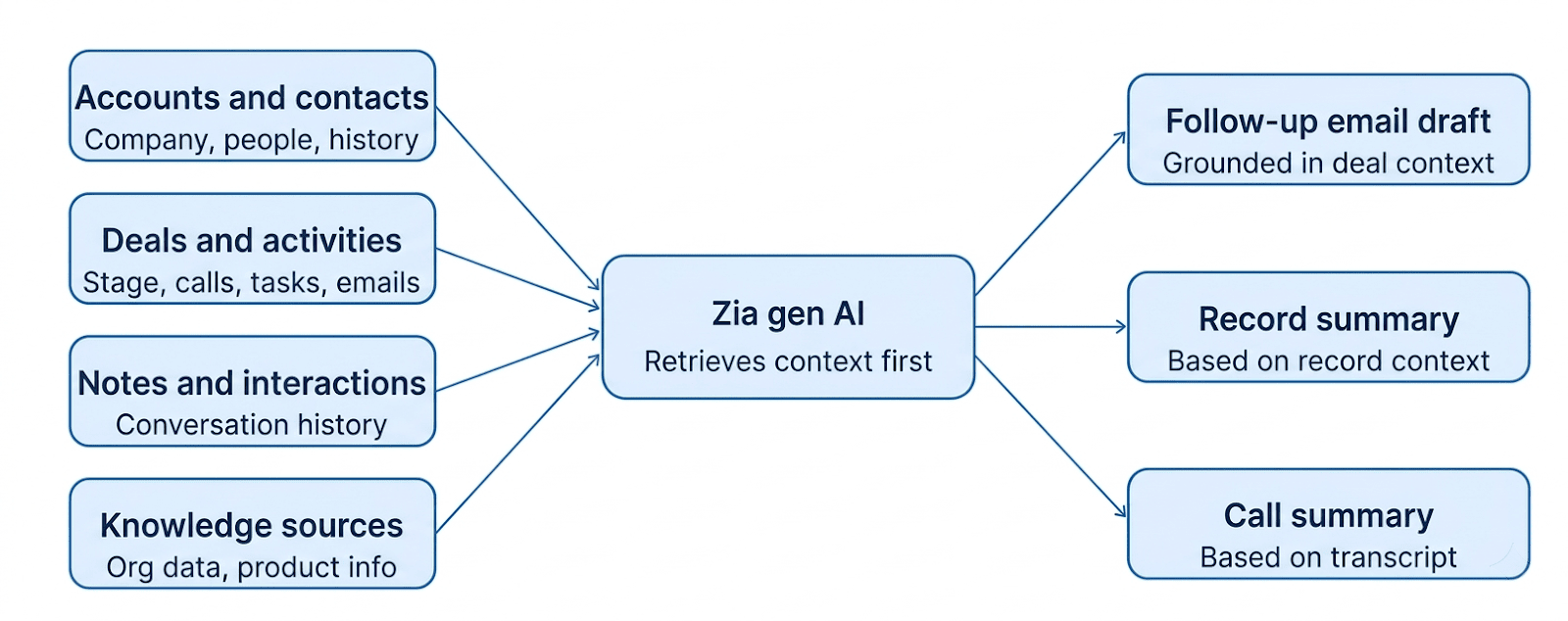
This retrieval-first approach is the core of how grounding works in Zia. The generation is constrained by what is actually in the record. When generating outputs like sales emails, meeting summaries, or deal insights, Zia retrieves relevant data from CRM and uses it as contextual input, ensuring responses are aligned with the customer's actual sales data rather than relying on general model knowledge.
Smart prompts integrate the power of Zia and your choice of LLM. You can use smart prompts to generate or modify email templates, fetch valuable customer information from records, and summarise and enhance record notes.
The record is always the source. Zia is designed to minimize assumptions by prioritizing retrieved CRM context.
Traceability: Users can review the underlying data that contributed to the output
Generative outputs in Zoho CRM are not black boxes. Users can review the source data that influenced an output, whether that is deal notes, interaction history, or product information. This gives sales teams the ability to validate generated insights before acting on them.
For report creation specifically, Zia's report creation offers co-creation functionality where you can take control at any point, refine configurations, and hand control back to Zia when needed.
Users can also access their previous requests without starting over, and review the reasons behind Zia's responses. Every output is anchored to the specific record that produced it, so cross-checking the underlying data is always one click away.
Data access controls: AI only sees what you can see
Zia's generative AI respects your existing CRM permission structure. Users only receive AI-generated insights based on the data they are authorised to access. Sensitive customer information is protected through the same security model used across the CRM platform, ensuring AI does not expose restricted data.
Digital Employees respect defined user access permissions, maintaining the same permissions structures already defined within the organisation.
This is not a separate AI governance layer. It is the same role-based access control that governs everything else in Zoho CRM, applied consistently to every generative output.
Hallucination prevention: how Zia avoids making things up
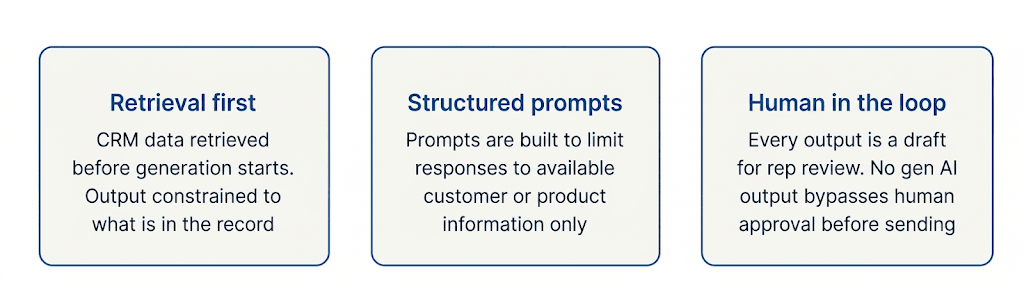
Three mechanisms work together to reduce the likelihood of fabricated or inaccurate outputs.
- Retrieval-based context first. Before any content is generated, Zia retrieves relevant data from your CRM records and uses that as the input context. Generation is constrained to what is actually in the record. When relevant data is insufficient, the AI indicates uncertainty rather than generating speculative responses.
- Structured prompts. Prompts are built to limit responses to available customer or product information. With the prompt builder for custom buttons, you can create your own AI instructions to generate tailored content, suggestions, or summaries across record pages and list views. The built-in editor lets you write clear instructions, set response style and length, and preview the output with sample record data before implementation. The preview step means admins can validate how prompts behave on real data before deploying them to the team.
- Human review at every step. No generative output in Zoho CRM is designed to bypass the rep. Zia produces a draft. The rep reviews it. The system includes validation and filtering layers that flag low-confidence or unsupported outputs. Nothing gets sent to a prospect without a human deciding to send it.
User feedback loop: outputs improve over time
Users can review and provide feedback on generated content, whether an email suggestion was inaccurate, a summary missed the point, or a recommendation was irrelevant. This feedback is logged and used to improve prompt design continuously, retrieval logic, and model behaviour, making Zia's outputs more accurate over time as it learns from real usage within your organisation.
The LLM choice: privacy built into the infrastructure
The grounding and privacy story extends all the way down to which model is generating the output.
While Zoho supports self-hosted open source LLMs like Llama and DeepSeek. Zia LLM continues Zoho's commitment to data privacy by allowing customers to keep their data on Zoho servers, leveraging the latest AI capabilities without sending their data to AI cloud providers.
Zoho also supports various third-party LLMs, including those from OpenAI, Google, and others. If customers prefer to use those models, they can do so through the vendor's AI Bridge.
The default is privacy-first. Unlike large LLMs that often rely on third-party cloud infrastructure, Zoho's in-house Zia LLM has been deployed across Zoho's data centres in the US, India, and Europe, ensuring the data never leaves Zoho's ecosystem.
For organisations in regulated industries or regions with strict data residency requirements, this is a meaningful architectural distinction: generative AI that runs entirely on infrastructure Zoho owns and operates, with no data leaving to external AI cloud providers.