Zoho CRM's AI Innovation Priorities for the Next 24 Months
Here is where Zoho CRM is investing over the next two years, what is being built, what is being left behind, and why.
The strategic shift in one sentence
The direction is a deliberate move away from manual, rule-based workflow configuration toward AI-driven sales orchestration that acts on real buyer signals, not predefined logic trees.
What we are building: five focus areas
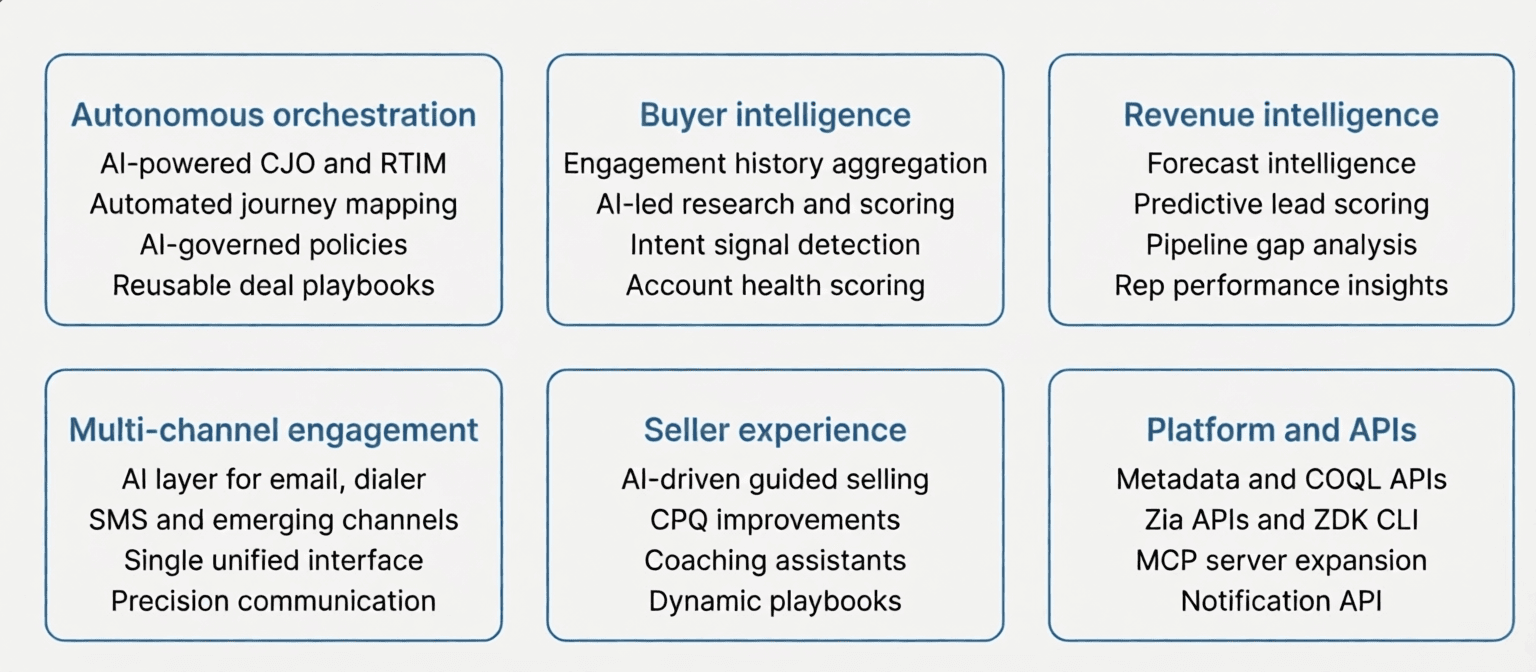
1. Autonomous sales orchestration
The biggest investment area. The goal is to move from workflows that fire when a human defines every trigger and condition, to AI-driven orchestration that adapts based on what buyers are actually doing.
This means building out AI-powered Customer Journey Orchestration (CJO) and Real-Time Interaction Management (RTIM), automated journey mapping and execution, and reusable orchestration patterns like guided selling cadences and deal playbooks. Instead of admins configuring static rule trees, the system increasingly governs itself based on AI policies and live buyer signals.
CommandCenter, Zoho CRM's customer journey orchestration platform, is the primary vehicle for this, with AI recommending multi-step qualification cadences and next-best actions across channels based on where each buyer actually is in their journey.
2. Buyer intelligence
The priority here is building a richer, more dynamic picture of each prospect before a rep even picks up the phone.
This involves aggregating engagement histories, AI-led research, and intent signals into unified prospect scores, with tighter integration between lead capture, routing, and predictive lead scoring. The outcome is that AI prioritises and routes leads not just by demographic fit but by actual buying intent, and recommends the right qualification approach for each prospect based on their signals.
Account health scoring extends this to existing customers, giving customer success and expansion teams the same signal-driven view that sales gets for new business.
3. Revenue intelligence
Investments here cover revenue forecast intelligence, predictive lead scoring improvements, pipeline gap analysis, and rep performance insights. The focus is on giving managers and revenue leaders a forward-looking, AI-driven view of the business rather than a backward-looking report of what already happened.
4. Multi-channel buyer engagement
The plan is to bring an AI layer across email, dialer, SMS, and emerging channels into a single interface. Today these channels often sit in separate tools or require reps to context-switch. The direction is a unified engagement layer where AI handles precision communication, surfacing the right message, at the right time, through the right channel, for each individual buyer.
Next Best Experience (NBX) gets significantly improved as part of this, with more contextual and timely action recommendations at each deal stage.
5. Seller-facing AI experience
This covers AI-driven guided selling and CPQ improvements, sales coaching assistants that help reps prepare for calls and refine pitches, dynamic playbooks that adapt to deal context rather than presenting static scripts, and conversational intelligence improvements that surface insights from every rep-buyer interaction.
6. Platform and developer capabilities
On the platform side, the investments are in Metadata APIs, Query API (COQL), Notification API, Zia APIs, ZDK CLI and Client Scripts, and MCP server expansion. These are the building blocks that partners, ISVs, and technical customers use to extend and integrate Zoho CRM. Stronger APIs and a more capable MCP server mean the AI capabilities Zoho builds can also be surfaced and extended by the ecosystem.
What is being de-prioritised
This is the trade-off that the strategic shift implies, and it is worth being direct about.
Purely static, rule-based automations that require extensive manual configuration and do not utilise activity intelligence or buyer signals are being de-emphasised. This does not mean existing workflow rules stop working. It means new investment is not going into making those easier to build.
The bet is that the right long-term answer is AI-governed policies and orchestration patterns, not more sophisticated rule builders. A workflow that fires because a field changed is being replaced by an agent that acts because a buyer signal indicates it is the right moment.
What this means in practice for customers: Teams that have invested heavily in complex, manually configured workflow automation may find that the new capabilities require a different approach to process design. The shift is from "configure every step" to "define the goal and guardrails, let AI handle the path." That is a meaningful change in how sales operations teams think about automation, and it is the deliberate direction.