

- HOME
- Taxes & compliance
- UAE eInvoicing Glossary
UAE eInvoicing Glossary
Key terms and definitions for the UAE Electronic Invoicing System
Sources
Definitions in this glossary are drawn from the UAE Ministry of Finance's official eInvoicing decisions and guidelines, cross-referenced with the underlying VAT and Corporate Tax legislation and the UAE Government's own digital invoicing page:
- Digital invoicing (The Official Portal of the UAE Government)
- Ministerial Decision No. 243 of 2025 on the Electronic Invoicing System (Ministry of Finance)
- Ministerial Decision No. 64 of 2025 on the Eligibility Criteria and Accreditation Procedure for Service Providers (Ministry of Finance)
- UAE Electronic Invoicing Guidelines, V1.0 (Ministry of Finance, PDF)
- UAE eInvoicing Programme Introduction (Ministry of Finance, PDF)
- Federal Decree-Law No. 8 of 2017 on Value Added Tax (Federal Tax Authority, PDF)
- Federal Decree-Law No. 47 of 2022 on the Taxation of Corporations and Businesses (Ministry of Finance, PDF)
5
5 Corner model
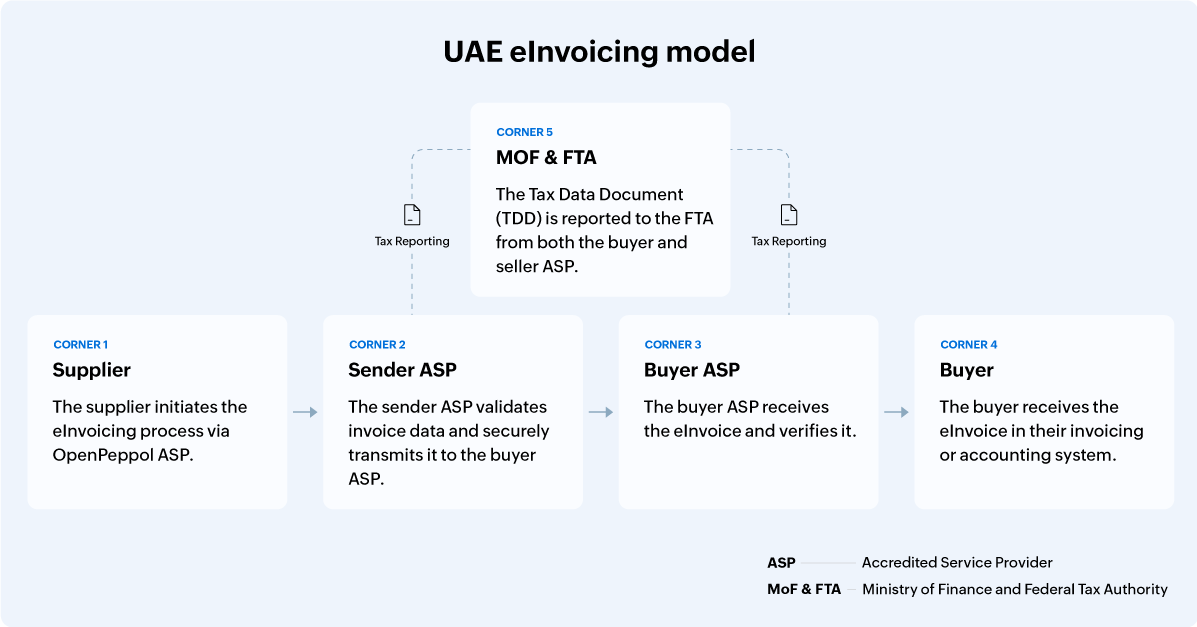
The decentralised architectural framework governing how electronic invoices are issued, validated, transmitted, and reported in the UAE. Each corner represents a distinct party or system: Corner 1 is the Supplier; Corner 2 is the Supplier's Accredited Service Provider (ASP), which validates and transmits; Corner 3 is the Buyer's ASP, which receives and reports tax data to the FTA; Corner 4 is the Recipient (buyer); Corner 5 is the FTA, which receives tax data reports and sends electronic confirmations. The model is built on the Peppol Interoperability Framework and ensures end-to-end traceability.
A
Accreditation
The formal approval granted by the UAE Ministry of Finance to a Service Provider, authorising it to operate as an Accredited Service Provider (ASP) within the UAE Electronic Invoicing System. Governed by Ministerial Decision No. 64 of 2025, accreditation requires Peppol membership, UAE company registration, technical capability for PINT-AE billing specifications, and compliance with data security standards. Accreditation must be renewed periodically, and the Ministry may revoke it for non-compliance.
Accredited Service Provider ASP
A technology service provider granted Accreditation by the UAE Ministry of Finance to provide e-Invoicing services within the 5 Corner model. An ASP acts as both Corner 2 (sender's access point) and Corner 3 (receiver's access point) on the Peppol network. Responsibilities include validating invoice data, converting it to PINT-AE compliant XML, transmitting to the buyer's ASP, reporting tax data to the FTA, generating UUIDs, and sending confirmation messages. Every Person or Government Entities in scope must appoint one ASP.
Airway Bill
An electronic document issued by an airline confirming receipt of cargo and evidencing the contract of carriage for goods transported by air. International transportation of goods by air where an Airway Bill is issued is excluded from e-invoicing for a temporary period of 24 months from the effective date of the Electronic Invoicing System.
B
B2B Business to Business
A transaction category where both supplier and buyer are Persons conducting business under UAE law. B2B transactions are fully within scope of the UAE e-Invoicing System. The supplier must issue an Electronic Invoice through their ASP regardless of whether the buyer has onboarded. If the buyer has no Participant Identifier, the supplier must use the predefined endpoint 0235:9900000098.
B2G Business to Government
A transaction category where a business supplies goods or services to a government entity. Fully within scope of the UAE eInvoicing system, including supplies through government procurement portals. Government Entities have a mandatory implementation deadline of 1 October 2027, with a last date to appoint an ASP of 31 March 2027.
Business
Any activity conducted regularly, on an ongoing and independent basis by any Person, in any location — including industrial, commercial, agricultural, professional, vocational, service, or excavation activities, or anything related to the use of tangible or intangible properties. This is the primary determinant for eInvoicing scope. Investment holding companies that only earn passive income and do not carry out economic activity are generally outside the scope of e-invoicing. However, if they engage in taxable activities such as recharges or inter-company services for consideration, they are considered to be conducting business and fall within scope.
Business Transaction
Any transaction conducted in full or in part by a Person during its Business. Business Transactions between businesses and/or Government Entities are in scope for e-Invoicing. Transactions involving consumers (natural persons not in business) are explicitly excluded, regardless of whether a billing agent is used. The scope includes B2B, B2G, G2B, and G2G transaction types.
C
Central Register
The official repository maintained by the UAE Ministry of Finance containing the list of all Accredited Service Providers and the list of all End Users onboarded by those ASPs. The Central Register supports participant discovery by enabling ASPs to verify and obtain a buyer's Participant Identifier, which is then used within the Peppol network (via SML/SMP) to route Electronic Invoices.
Commercial Invoice
An eInvoice issued for a Business Transaction that does not constitute a taxable supply requiring a Tax Invoice under the VAT Decree-Law. This includes VAT-exempt, out-of-scope, or supplies by non-VAT-registered Persons. Paper or PDF commercial invoices must be replaced by eInvoices meeting PINT-AE specifications. The Tax Registration Number is not mandatory on a Commercial Invoice, unlike on an electronic Tax Invoice. Self-billing is not available for Commercial Invoices.
Corporate Tax Decree-Law
Federal Decree-Law No. 47 of 2022 on the taxation of corporations and businesses, including all subsequent amendments. Relevant to eInvoicing in determining who qualifies as a Taxable Person — any person subject to Corporate Tax is a Taxable Person with specific e-Invoice obligations, including the requirement to issue electronic Tax Invoices for taxable supplies.
E
Electronic Credit Note
A structured electronic document issued, transmitted, and received through the UAE electronic invoicing system via the 5 Corner model, used to record a reduction, cancellation, or adjustment to a previously issued Electronic Invoice. Must comply with PINT-AE billing specifications and is transmitted in XML format. A single Electronic Credit Note can reference multiple prior Electronic Invoices. Partial credit notes are permitted.
Electronic Invoice
A structured digital invoice issued, transmitted, and received through the UAE Electronic Invoicing System, formatted in XML in accordance with Peppol's PINT-AE billing specifications. Issued and transmitted through the 5 Corner model via accredited ASPs and made available to the FTA in accordance with reporting requirements. An Electronic Invoice that complies with Article 65 of the VAT Decree-Law fulfils the Tax Invoice obligation.
Electronic Invoice Data
The complete set of mandatory data fields a supplier must provide to their ASP to generate a valid Electronic Invoice or Electronic Credit Note, as specified by the Ministry of Finance under PINT-AE billing standards. Includes supplier and buyer identification (Tax Registration Number, Tax Identification Number, Participant Identifier, legal registration), line-item data (description, quantity, unit price, tax category, tax rate, tax amount), document-level totals, payment information, and scenario-specific fields such as beneficiary details for Free Zone transactions.
Electronic Invoicing System
The end-to-end national infrastructure for the issuance, transmission, exchange, and sharing of Electronic Invoice and Electronic Credit Note data between suppliers, buyers, ASPs, and the FTA. Built on the Peppol Interoperability Framework and the 5 Corner model. Supports both Arabic and English. Mandatory for all Persons conducting Business in the UAE for every Business Transaction, unless specifically excluded under Article 4 of MD No. 243 of 2025.
Electronic Ticket
An electronic document issued by an airline containing the conditions of a passenger carriage contract, replacing a traditional paper ticket. International passenger transportation services by airline for which an Electronic Ticket is issued are excluded from UAE Electronic Invoicing System requirements.
End User
An identified or identifiable legal or natural entity responsible for the business content of invoice datasets exchanged as sender or receiver using Peppol Services. In the UAE context, End Users are Persons and Government Entities that have onboarded with an ASP and are registered in the Central Register. Each end user is assigned a unique Participant Identifier (Peppol ID) by the FTA upon onboarding.
F
Free Zone
A designated geographic area within the UAE specified by a Cabinet decision. Free Zone entities — as supplier, buyer, or beneficiary — trigger specific eInvoice requirements under Scenario 1 of the PINT-AE specifications. When the customer is a Free Zone entity, the Electronic Invoice must include beneficiary details in addition to standard customer information. The beneficiary is the Person or entity that ultimately uses, consumes, or owns what is being supplied.
FTA Federal Tax Authority
The UAE government body responsible for administering and enforcing federal tax legislation. In Electronic Invoicing, the FTA serves as Corner 5 of the 5 Corner model — receiving Tax Data reported by both the supplier's ASP (Corner 2) and the buyer's ASP (Corner 3) for every Electronic Invoice exchanged.
G
G2B Government to Business
A transaction category where a Government Entity supplies goods or services to a business. G2B transactions are within the scope of E-Invoicing, subject to the Government Entity's mandatory implementation date of 1 October 2027, except where the transaction qualifies as a sovereign activity exclusion.
G2G Government to Government
A transaction category where one Government Entity supplies goods or services to another. G2G transactions are within scope of E-Invoicing, subject to the same 1 October 2027 implementation timeline as G2B, unless the transaction qualifies as a sovereign activity conducted in a non-commercial capacity and not in competition with the private sector.
Government Entities
Ministries, government departments and agencies, authorities, and public institutions in the UAE, whether Federal or local, including any other entities treated as Government Entities under Cabinet decisions issued for VAT purposes. Subject to Electronic Invoicing obligations with a mandatory go-live date of 1 October 2027 and a deadline to appoint an ASP of 31 March 2027.
I
Issuer
Any Person or Government Entity legally obligated to issue, transmit, share, and exchange Electronic Invoices and Electronic Credit Notes through the UAE Electronic Invoicing System. The compliance obligation rests with the Issuer (typically the supplier), even where an agent or e-commerce platform issues invoices on their behalf. In self-billing arrangements, the buyer acts as Issuer.
O
OpenPeppol
An international non-profit association headquartered in Brussels, responsible for developing, maintaining, and governing the Peppol Interoperability Framework. OpenPeppol issues Peppol Service Provider Agreements to authorised Service Providers worldwide, certifies access points, and ensures all participants adhere to current specifications. The UAE Ministry of Finance coordinates with OpenPeppol to ensure UAE ASPs comply with the latest PINT-AE requirements.
P
Participant Identifier End Point ID
A unique identifier assigned to every Person or Government Entity registered on the UAE Peppol network, issued by the FTA during onboarding. Formatted as the prefix 0235 followed by the entity's 10-digit Tax Identification Number — for example, 0235:1234567890. Used by the sending ASP to look up the receiving ASP in the Peppol directory and route the Electronic Invoice. For buyers not yet onboarded, suppliers use placeholder endpoints: 0235:9900000098 (domestic) or 0235:9900000099 (foreign).
Peppol Pan-European Public Procurement Online
An international open standard and network infrastructure originally developed for European public procurement, now adopted globally. The UAE has adopted Peppol as the technical backbone of its Electronic Invoicing System. Peppol defines document formats (via PINT-AE for the UAE), access point requirements, governance framework, and the directory service that enables routing between ASPs worldwide. Using Peppol allows UAE businesses to exchange Electronic Invoices domestically and with counterparties in other Peppol-enabled jurisdictions.
Peppol Interoperability Framework
The combined technical and governance structure underpinning the Peppol network, consisting of the Peppol Architectural Framework (technical specifications for business process interoperability) and the Peppol Governance Framework (agreements, internal regulations, and operational procedures). Together they ensure Electronic Invoices can be exchanged seamlessly between different ASPs and across countries while maintaining data integrity, security, and compliance with local requirements.
Person
Any natural person (individual) or juridical person (company, partnership, or other legal entity). Under the UAE Electronic Invoicing framework, all Persons conducting Business in the UAE — regardless of VAT registration status, size, or place of establishment — are within scope for every Business Transaction, unless specifically excluded. Non-UAE established Persons obligated to issue Tax Invoices under the VAT Decree-Law must also issue them as Electronic Invoices.
PINT-AE
The UAE-specific implementation of the Peppol International (PINT) billing specification, defining the exact technical format, mandatory fields, optional fields, code lists, and validation rules for Electronic Invoices and Electronic Credit Notes in the UAE. Based on the global PINT methodology, enabling interoperability while allowing national customisation. XML examples and the full data dictionary are published on the Peppol website.
Provisional Invoice
An invoice issued before all final transaction details — such as quantity, final price, or taxes — have been determined. Under the UAE Electronic Invoicing System, there is no separate category for provisional invoices — every provisional invoice must be issued as an Electronic Invoice. Upward or downward adjustments are handled by issuing either an additional Electronic Invoice or an Electronic Credit Note.
R
Recipient
Any Person or Government Entity that receives Electronic Invoices and Electronic Credit Notes through the UAE Electronic Invoicing System via their appointed ASP (Corner 3). The Recipient's ASP validates the incoming invoice, delivers it in an agreed format, and reports Tax Data to the FTA. The Recipient's onboarding or tax registration status does not affect the supplier's obligation to issue an Electronic Invoice.
Revenue
The gross income earned by a Person during their most recent accounting period, based on financial statements prepared under applicable UAE legislation. Revenue determines a Person's mandatory Electronic Invoicing implementation timeline: Persons with annual Revenue of AED 50,000,000 or more must implement by 1 January 2027 (ASP appointment deadline: 31 July 2026); Persons with Revenue below AED 50,000,000 must implement by 1 July 2027 (ASP appointment deadline: 31 March 2027).
S
Service Provider
An organisation authorised by OpenPeppol to access the Peppol Interoperability Framework as a Peppol access point operator. In the UAE context, a Service Provider must additionally obtain Accreditation from the Ministry of Finance before operating as an ASP and onboarding UAE businesses and Government Entities. The terms Service Provider and ASP are often used interchangeably, though technically an ASP is a Service Provider that has completed UAE-specific Accreditation.
T
Tax Credit Note
A written or electronic document recording any amendment to reduce or cancel a Taxable Supply and its details. Once a supplier is in scope for Electronic Invoicing, the Tax Credit Note must be issued as an Electronic Credit Note through the system. Issued when a reduction in Output Tax occurs — for example, due to a return of goods, pricing error, or post-supply discount. A single electronic Tax Credit Note may reference multiple prior electronic Tax Invoices, and partial credit notes are permitted.
Tax Group
Two or more Persons registered with the FTA for VAT purposes as a single Taxable Person. Business Transactions between members of the same VAT group are within scope of Electronic Invoicing. A temporary grace period applies: intra-group transactions are exempt from Electronic Invoicing obligations for 24 months commencing 1 January 2027. After this period, full compliance is required. Each individual member must onboard separately with an ASP using their own Tax Identification Number.
Tax Identification Number TIN
A unique 10-digit identifier assigned to every entity registered with the FTA for any tax type. Derived from the first 10 digits of the entity's 15-digit Tax Registration Number. The TIN serves as the primary identifier for e-Invoicing — it forms the basis of the entity's Participant Identifier (formatted as 0235 followed by the 10-digit TIN). Persons in scope who are not already FTA-registered must register solely to obtain a TIN. Tax Group members each have their own individual TIN.
Tax Invoice
A written or electronic document recording a Taxable Supply and its details, required under Article 65 of the VAT Decree-Law and Article 59 of the VAT Executive Regulation. Once subject to the Electronic Invoicing System, Tax Invoices must be issued as Electronic Invoices. An Electronic Invoice meeting all Tax Invoice requirements simultaneously satisfies both obligations, provided the buyer has also implemented Electronic Invoicing. Where the buyer has not yet implemented, a traditional Tax Invoice (e.g. PDF) must also be issued to support the buyer's input tax recovery.
Tax Registration Number TRN
A unique 15-digit number issued by the FTA to each Person registered for tax purposes in the UAE. The first 10 digits constitute the Tax Identification Number, used for Electronic Invoicing onboarding and as the basis for the Participant Identifier. The TRN must be included on all electronic Tax Invoices and electronic Tax Credit Notes, but is not mandatory on Commercial Invoices or invoices for exempt or out-of-scope transactions.
Taxable Person
Any Person registered or obligated to register for tax purposes under the VAT Decree-Law, or subject to Corporate Tax under the Corporate Tax Decree-Law. Taxable Persons have specific Electronic Invoicing obligations beyond those of non-registered Persons — they must issue electronic Tax Invoices for Taxable Supplies, include their Tax Registration Number on such invoices, and retain Electronic Invoice data for 5 years following the relevant Tax Period (plus an additional 4 years in the event of a dispute or tax audit).
Taxable Supply
A supply of goods or services made for consideration in the course of Business by any Person in the UAE, excluding Exempt Supply. Taxable Supplies are subject to VAT at the standard rate (5%) or zero rate (0%) and must be documented via electronic Tax Invoices once the supplier is in scope. The tax category field on an Electronic Invoice must correctly classify each line item — options include Standard Rate, Zero Rated, Exempt from VAT, Outside the Scope of VAT, Reverse Charge, and Margin Scheme.
U
UUID Universally Unique Identifier
A unique 128-bit identifier generated algorithmically by the ASP (Corner 2) for every Electronic Invoice processed through the UAE Electronic Invoicing System. Assigned in addition to the supplier's own sequential invoice number, the UUID is the system-level unique reference that prevents duplication within the network. It is a mandatory field on every Electronic Invoice and is used by both ASPs and the FTA for tracking, reconciliation, and audit purposes.
V
VAT Decree-Law
Federal Decree-Law No. 8 of 2017 on Value Added Tax, including all subsequent amendments. The primary legal basis for Tax Invoice obligations in the UAE. Amended to incorporate Electronic Invoicing requirements — notably, Article 65(5) now requires that Persons subject to the Electronic Invoicing System issue Tax Invoices and Tax Credit Notes in the form of Electronic Invoices and Electronic Credit Notes. The revised definition of a Tax Invoice explicitly includes an Electronic Invoice.
X
XML eXtensible Markup Language
A structured, machine-readable, text-based data format used to represent Electronic Invoices in a standardised and interoperable way. All Electronic Invoices in the UAE system are issued, transmitted, and received in XML format, specifically conforming to the PINT-AE billing specification. XML enables automatic processing by accounting systems, ERP platforms, and ASPs without human intervention. Unlike PDF or paper invoices, XML invoices contain data in discrete, labelled fields that can be directly ingested by receiving systems. Electronic Invoices in the UAE do not carry a QR code or barcode — the XML file is the authoritative document.